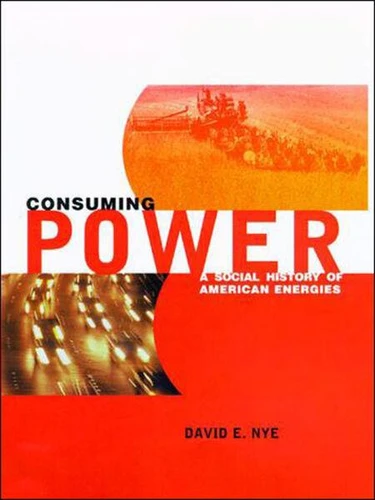
Consuming Power. A Social History of American Energies
Par :Formats :
Disponible dans votre compte client Decitre ou Furet du Nord dès validation de votre commande. Le format ePub protégé est :
- Compatible avec une lecture sur My Vivlio (smartphone, tablette, ordinateur)
- Compatible avec une lecture sur liseuses Vivlio
- Pour les liseuses autres que Vivlio, vous devez utiliser le logiciel Adobe Digital Edition. Non compatible avec la lecture sur les liseuses Kindle, Remarkable et Sony
- Non compatible avec un achat hors France métropolitaine
 , qui est-ce ?
Notre partenaire de plateforme de lecture numérique où vous retrouverez l'ensemble de vos ebooks gratuitement
Pour en savoir plus sur nos ebooks, consultez notre aide en ligne ici
C'est si simple ! Lisez votre ebook avec l'app Vivlio sur votre tablette, mobile ou ordinateur :

- Nombre de pages352
- FormatePub
- ISBN0-262-26102-2
- EAN9780262261029
- Date de parution18/02/1999
- Protection num.Adobe DRM
- Taille1 Mo
- Infos supplémentairesepub
- ÉditeurThe MIT Press
Résumé
Nye uses energy as a touchstone to examine the lives of ordinary people engaged in normal activities. How did the United States become the world's largest consumer of energy? David Nye shows that this is less a question about the development of technology than it is a question about the development of culture. In Consuming Power, Nye uses energy as a touchstone to examine the lives of ordinary people engaged in normal activities.
He looks at how these activities changed as new energy systems were constructed, from colonial times to recent years. He also shows how, as Americans incorporated new machines and processes into their lives, they became ensnared in power systems that were not easily changed: they made choices about the conduct of their lives, and those choices accumulated to produce a consuming culture. Nye examines a sequence of large systems that acquired and then lost technological momentum over the course of American history, including water power, steam power, electricity, the internal-combustion engine, atomic power, and computerization.
He shows how each system became part of a larger set of social constructions through its links to the home, the factory, and the city. The result is a social history of America as seen through the lens of energy consumption.
He looks at how these activities changed as new energy systems were constructed, from colonial times to recent years. He also shows how, as Americans incorporated new machines and processes into their lives, they became ensnared in power systems that were not easily changed: they made choices about the conduct of their lives, and those choices accumulated to produce a consuming culture. Nye examines a sequence of large systems that acquired and then lost technological momentum over the course of American history, including water power, steam power, electricity, the internal-combustion engine, atomic power, and computerization.
He shows how each system became part of a larger set of social constructions through its links to the home, the factory, and the city. The result is a social history of America as seen through the lens of energy consumption.