
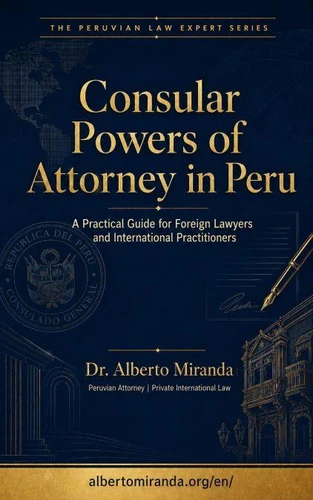
Consular Powers of Attorney in Peru. The Peruvian Law Expert Series, #3
Par :Formats :
Disponible dans votre compte client Decitre ou Furet du Nord dès validation de votre commande. Le format ePub est :
- Compatible avec une lecture sur My Vivlio (smartphone, tablette, ordinateur)
- Compatible avec une lecture sur liseuses Vivlio
- Pour les liseuses autres que Vivlio, vous devez utiliser le logiciel Adobe Digital Edition. Non compatible avec la lecture sur les liseuses Kindle, Remarkable et Sony
 , qui est-ce ?
Notre partenaire de plateforme de lecture numérique où vous retrouverez l'ensemble de vos ebooks gratuitement
Pour en savoir plus sur nos ebooks, consultez notre aide en ligne ici
C'est si simple ! Lisez votre ebook avec l'app Vivlio sur votre tablette, mobile ou ordinateur :

- FormatePub
- ISBN8235920941
- EAN9798235920941
- Date de parution15/05/2026
- Protection num.pas de protection
- Infos supplémentairesepub
- ÉditeurIoakim Ioakim
Résumé
Consular powers of attorney are essential instruments for cross-border legal matters involving Peru. This guide explains how powers of attorney are drafted, executed, authenticated, and used before Peruvian notaries, courts, public registries, consulates, and administrative authorities. Written by Dr. Alberto Miranda, a Peruvian attorney based in Lima, this book is designed for foreign lawyers, international practitioners, and parties with legal matters connected to Peru.
It provides a practical overview of the Peruvian legal framework governing powers of attorney, including consular execution, apostille requirements, legalization procedures, certified translations, institutional review, and the practical risks that commonly arise when documents are prepared abroad for use in Peru. The book covers the most common uses of consular powers of attorney in Peru, including real estate transactions, civil and commercial matters, family law proceedings, notarial divorce by mutual consent, succession and estate management, corporate representation, administrative procedures, and filings before Peruvian institutions such as SUNARP, RENIEC, SUNAT, notaries, and courts.
Readers will learn why powers of attorney often fail in cross-border practice, how to distinguish between general and specific powers, when apostille or consular legalization is required, what wording Peruvian institutions may expect, and why legal review before execution is critical to avoid rejection, delay, or the need to repeat the consular process. This book includes practical examples, checklists, comparative references, frequently asked questions, and illustrative scenarios designed to help readers understand how consular powers operate in real legal practice involving Peru.
The content is provided for general informational and educational purposes only. It does not constitute legal advice, a formal legal opinion, or a substitute for case-specific guidance from a qualified Peruvian lawyer.
It provides a practical overview of the Peruvian legal framework governing powers of attorney, including consular execution, apostille requirements, legalization procedures, certified translations, institutional review, and the practical risks that commonly arise when documents are prepared abroad for use in Peru. The book covers the most common uses of consular powers of attorney in Peru, including real estate transactions, civil and commercial matters, family law proceedings, notarial divorce by mutual consent, succession and estate management, corporate representation, administrative procedures, and filings before Peruvian institutions such as SUNARP, RENIEC, SUNAT, notaries, and courts.
Readers will learn why powers of attorney often fail in cross-border practice, how to distinguish between general and specific powers, when apostille or consular legalization is required, what wording Peruvian institutions may expect, and why legal review before execution is critical to avoid rejection, delay, or the need to repeat the consular process. This book includes practical examples, checklists, comparative references, frequently asked questions, and illustrative scenarios designed to help readers understand how consular powers operate in real legal practice involving Peru.
The content is provided for general informational and educational purposes only. It does not constitute legal advice, a formal legal opinion, or a substitute for case-specific guidance from a qualified Peruvian lawyer.
A propos de Alberto Miranda

17,49 €

2,99 €

2,99 €

10,99 €