
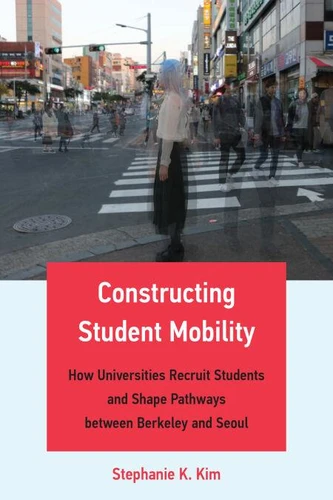
Constructing Student Mobility. How Universities Recruit Students and Shape Pathways between Berkeley and Seoul
Par :Formats :
Disponible dans votre compte client Decitre ou Furet du Nord dès validation de votre commande. Le format ePub protégé est :
- Compatible avec une lecture sur My Vivlio (smartphone, tablette, ordinateur)
- Compatible avec une lecture sur liseuses Vivlio
- Pour les liseuses autres que Vivlio, vous devez utiliser le logiciel Adobe Digital Edition. Non compatible avec la lecture sur les liseuses Kindle, Remarkable et Sony
- Non compatible avec un achat hors France métropolitaine
 , qui est-ce ?
Notre partenaire de plateforme de lecture numérique où vous retrouverez l'ensemble de vos ebooks gratuitement
Pour en savoir plus sur nos ebooks, consultez notre aide en ligne ici
C'est si simple ! Lisez votre ebook avec l'app Vivlio sur votre tablette, mobile ou ordinateur :

- Nombre de pages226
- FormatePub
- ISBN978-0-262-37338-8
- EAN9780262373388
- Date de parution04/04/2023
- Protection num.Adobe DRM
- Taille450 Ko
- Infos supplémentairesepub
- ÉditeurThe MIT Press
Résumé
How universities in the US and South Korea compete for global student markets-and how university financials shape students' lives. The popular image of the international student in the American imagination is one of affluence, access, and privilege, but is that image accurate? In this provocative book, higher education scholar Stephanie Kim challenges this view, arguing that universities-not the students-allow students their international mobility.
Focusing on universities in the US and South Korea that aggressively grew their student pools in the aftermath of the Great Recession, Kim shows the lengths universities will go to expand enrollments as they draw from the same pool of top South Korean students. Kim closely follows several students attending a university in Berkeley and a university in Seoul. They have chosen different paths to study abroad or learn at home, but all are seeking a transformative educational experience.
To show how student mobility depends on institutional structures, Kim demonstrates how the universities themselves compel students' choices to pursue higher learning at one institution or another. She also profiles the people who help ensure the global student supply chain runs smoothly, from education agents in South Korea to community college recruiters in California. Using ethnographic research gathered over a ten-year period in which international admissions were impacted by the Great Recession, changes in US presidential administrations, and the COVID-19 pandemic, Constructing Student Mobility provides crucial insights into the purpose, effects, and future of student recruitment across the Pacific.
Focusing on universities in the US and South Korea that aggressively grew their student pools in the aftermath of the Great Recession, Kim shows the lengths universities will go to expand enrollments as they draw from the same pool of top South Korean students. Kim closely follows several students attending a university in Berkeley and a university in Seoul. They have chosen different paths to study abroad or learn at home, but all are seeking a transformative educational experience.
To show how student mobility depends on institutional structures, Kim demonstrates how the universities themselves compel students' choices to pursue higher learning at one institution or another. She also profiles the people who help ensure the global student supply chain runs smoothly, from education agents in South Korea to community college recruiters in California. Using ethnographic research gathered over a ten-year period in which international admissions were impacted by the Great Recession, changes in US presidential administrations, and the COVID-19 pandemic, Constructing Student Mobility provides crucial insights into the purpose, effects, and future of student recruitment across the Pacific.