SOLDES
Jusqu'à -70% sur une sélection d'articles*

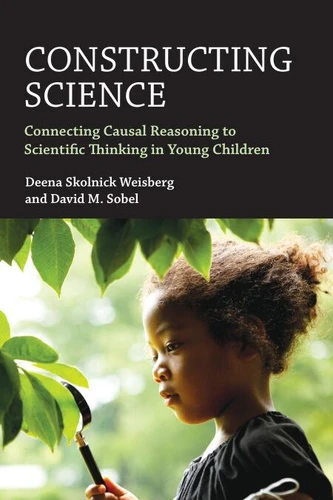
Constructing Science. Connecting Causal Reasoning to Scientific Thinking in Young Children
Par : ,Formats :
Disponible dans votre compte client Decitre ou Furet du Nord dès validation de votre commande. Le format ePub protégé est :
- Compatible avec une lecture sur My Vivlio (smartphone, tablette, ordinateur)
- Compatible avec une lecture sur liseuses Vivlio
- Pour les liseuses autres que Vivlio, vous devez utiliser le logiciel Adobe Digital Edition. Non compatible avec la lecture sur les liseuses Kindle, Remarkable et Sony
- Non compatible avec un achat hors France métropolitaine
 , qui est-ce ?
Notre partenaire de plateforme de lecture numérique où vous retrouverez l'ensemble de vos ebooks gratuitement
Pour en savoir plus sur nos ebooks, consultez notre aide en ligne ici
C'est si simple ! Lisez votre ebook avec l'app Vivlio sur votre tablette, mobile ou ordinateur :

- Nombre de pages392
- FormatePub
- ISBN978-0-262-37062-2
- EAN9780262370622
- Date de parution20/09/2022
- Protection num.Adobe DRM
- Taille7 Mo
- Infos supplémentairesepub
- ÉditeurThe MIT Press
Résumé
An examination of children's causal reasoning capacities and how those capacities serve as the foundation of their scientific thinking. Young children have remarkable capacities for causal reasoning, which are part of the foundation of their scientific thinking abilities. In Constructing Science, Deena Weisberg and David Sobel trace the ways that young children's sophisticated causal reasoning abilities combine with other cognitive, metacognitive, and social factors to develop into a more mature set of scientific thinking abilities.
Conceptualizing scientific thinking as the suite of skills that allows people to generate hypotheses, solve problems, and explain aspects of the world, Weisberg and Sobel argue that understanding how this capacity develops can offer insights into how we can become a more scientifically literate society. Investigating the development of causal reasoning and how it sets the stage for scientific thinking in the elementary school years and beyond, Weisberg and Sobel outline a framework for understanding how children represent and learn causal knowledge and identify key variables that differ between causal reasoning and scientific thinking.
They present empirical studies suggesting ways to bridge the gap between causal reasoning and scientific thinking, focusing on two factors: contextualization and metacognitive thinking abilities. Finally, they examine children's explicit understanding of such concepts as science, learning, play, and teaching.
Conceptualizing scientific thinking as the suite of skills that allows people to generate hypotheses, solve problems, and explain aspects of the world, Weisberg and Sobel argue that understanding how this capacity develops can offer insights into how we can become a more scientifically literate society. Investigating the development of causal reasoning and how it sets the stage for scientific thinking in the elementary school years and beyond, Weisberg and Sobel outline a framework for understanding how children represent and learn causal knowledge and identify key variables that differ between causal reasoning and scientific thinking.
They present empirical studies suggesting ways to bridge the gap between causal reasoning and scientific thinking, focusing on two factors: contextualization and metacognitive thinking abilities. Finally, they examine children's explicit understanding of such concepts as science, learning, play, and teaching.