
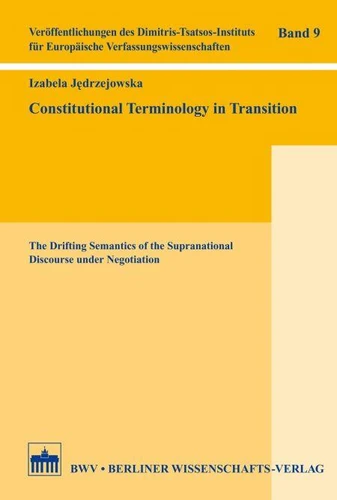
Constitutional Terminology in Transition. The Drifting Semantics of the Supranational Discourse under Negotiation
Par :Formats :
Disponible dans votre compte client Decitre ou Furet du Nord dès validation de votre commande. Le format PDF est :
- Compatible avec une lecture sur My Vivlio (smartphone, tablette, ordinateur)
- Compatible avec une lecture sur liseuses Vivlio
- Pour les liseuses autres que Vivlio, vous devez utiliser le logiciel Adobe Digital Edition. Non compatible avec la lecture sur les liseuses Kindle, Remarkable et Sony
 , qui est-ce ?
Notre partenaire de plateforme de lecture numérique où vous retrouverez l'ensemble de vos ebooks gratuitement
Pour en savoir plus sur nos ebooks, consultez notre aide en ligne ici
C'est si simple ! Lisez votre ebook avec l'app Vivlio sur votre tablette, mobile ou ordinateur :

- Nombre de pages237
- FormatPDF
- ISBN978-3-8305-2681-0
- EAN9783830526810
- Date de parution03/08/2012
- Protection num.Digital Watermarking
- Taille1019 Ko
- Infos supplémentairespdf
- ÉditeurBWV
Résumé
The study takes a broad interdisciplinary look at the legal and linguistic implications of the European integration process. It focuses on the operation of constitutional discourse at both the national and supranational level, and the transformation the said discourse is undergoing as a consequence of its transfer to the new European context. The author postulates the need to devise a new EU-specific constitutional discourse so as to adequately denote and describe the idiosyncratic reality of integrating Europe.
Other issues raised within the work involve inter alia: the translation of multilingual EU legal instruments, the specificity of negotiated European Union law, and the phenomenon of Europeanisation.°°Whilst far from being a comprehensive and exhaustive research, the book at hand constitutes an outlook on the latest developments in the post-statist constitutional discourse of the European Union milieu.
It attempts to address certain deficiencies in the linguistic means that could properly delimit the European legal space, as well as the appropriateness of conceiving of the Union in terms of a novel model of statehood, distinct both from federal and intergovernmental logic. One could argue that the EU constitutional linguistics remains too dynamic and distant for the peoples of Europe, albeit mighty enough to affect the trajectory of the European unification process for years to come.
Other issues raised within the work involve inter alia: the translation of multilingual EU legal instruments, the specificity of negotiated European Union law, and the phenomenon of Europeanisation.°°Whilst far from being a comprehensive and exhaustive research, the book at hand constitutes an outlook on the latest developments in the post-statist constitutional discourse of the European Union milieu.
It attempts to address certain deficiencies in the linguistic means that could properly delimit the European legal space, as well as the appropriateness of conceiving of the Union in terms of a novel model of statehood, distinct both from federal and intergovernmental logic. One could argue that the EU constitutional linguistics remains too dynamic and distant for the peoples of Europe, albeit mighty enough to affect the trajectory of the European unification process for years to come.