
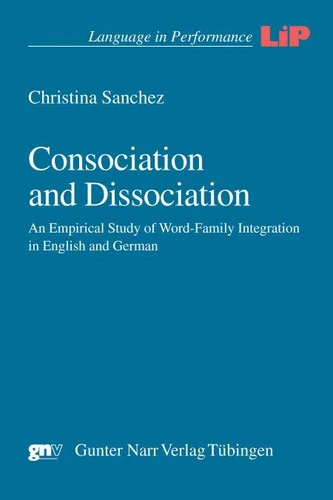
Consociation and Dissociation. An Empirical Study of Word-Family Integration in English and German
Par :Formats :
Disponible dans votre compte client Decitre ou Furet du Nord dès validation de votre commande. Le format PDF est :
- Compatible avec une lecture sur My Vivlio (smartphone, tablette, ordinateur)
- Compatible avec une lecture sur liseuses Vivlio
- Pour les liseuses autres que Vivlio, vous devez utiliser le logiciel Adobe Digital Edition. Non compatible avec la lecture sur les liseuses Kindle, Remarkable et Sony
 , qui est-ce ?
Notre partenaire de plateforme de lecture numérique où vous retrouverez l'ensemble de vos ebooks gratuitement
Pour en savoir plus sur nos ebooks, consultez notre aide en ligne ici
C'est si simple ! Lisez votre ebook avec l'app Vivlio sur votre tablette, mobile ou ordinateur :

- Nombre de pages294
- FormatPDF
- ISBN978-3-8233-7384-1
- EAN9783823373841
- Date de parution02/04/2008
- Protection num.Digital Watermarking
- Taille3 Mo
- Infos supplémentairespdf
- ÉditeurGunter Narr Verlag
Résumé
Since the middle of the twentieth century it has been widely believed that English words are less integrated into word families than German words. Ernst Leisi attributed this so-called dissociation to the large proportion of Romance words that have entered the originally Germanic English language in the course of its history. Even though fairly common, these hypotheses have not yet been tested empirically.
This book thus presents a long-due study which subjects the 2, 500 most frequent English and German lemmas to various analyses. For instance, they are analysed into constituents to which they are both formally and semantically related. In addition, morphosemantically related complex words containing the English and German list items are sought for. The approach adopted here, which considers a variety of variables such as formal differences and semantic obstacles, allows for a highly differentiated answer to the question whether the English vocabulary is dissociated or not.
The last part of the book discusses the relevance of the study's surprising results with respect to the mental lexicon as well as language learning and teaching.
This book thus presents a long-due study which subjects the 2, 500 most frequent English and German lemmas to various analyses. For instance, they are analysed into constituents to which they are both formally and semantically related. In addition, morphosemantically related complex words containing the English and German list items are sought for. The approach adopted here, which considers a variety of variables such as formal differences and semantic obstacles, allows for a highly differentiated answer to the question whether the English vocabulary is dissociated or not.
The last part of the book discusses the relevance of the study's surprising results with respect to the mental lexicon as well as language learning and teaching.