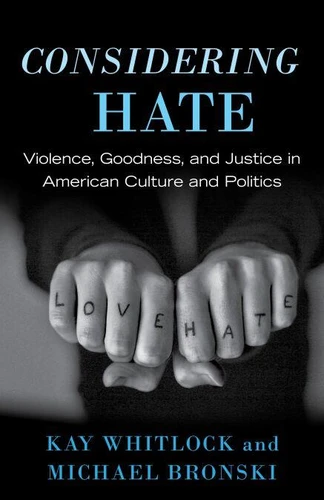
Considering Hate. Violence, Goodness, and Justice in American Culture and Politics
Par : ,Formats :
Disponible dans votre compte client Decitre ou Furet du Nord dès validation de votre commande. Le format ePub protégé est :
- Compatible avec une lecture sur My Vivlio (smartphone, tablette, ordinateur)
- Compatible avec une lecture sur liseuses Vivlio
- Pour les liseuses autres que Vivlio, vous devez utiliser le logiciel Adobe Digital Edition. Non compatible avec la lecture sur les liseuses Kindle, Remarkable et Sony
- Non compatible avec un achat hors France métropolitaine
 , qui est-ce ?
Notre partenaire de plateforme de lecture numérique où vous retrouverez l'ensemble de vos ebooks gratuitement
Pour en savoir plus sur nos ebooks, consultez notre aide en ligne ici
C'est si simple ! Lisez votre ebook avec l'app Vivlio sur votre tablette, mobile ou ordinateur :

- Nombre de pages184
- FormatePub
- ISBN978-0-8070-9192-0
- EAN9780807091920
- Date de parution06/01/2015
- Protection num.Adobe DRM
- Taille2 Mo
- Infos supplémentairesepub
- ÉditeurBeacon Press
Résumé
A provocative book about rethinking hatred and violence in America Over the centuries American society has been plagued by brutality fueled by disregard for the humanity of others: systemic violence against Native peoples, black people, and immigrants. More recent examples include the Steubenville rape case and the murders of Matthew Shepard, Jennifer Daugherty, Marcelo Lucero, and Trayvon Martin.
Most Americans see such acts as driven by hate. But is this right? Longtime activists and political theorists Kay Whitlock and Michael Bronski boldly assert that American society's reliance on the framework of hate to explain these acts is wrongheaded, misleading, and ultimately harmful. All too often Americans choose to believe that terrible cruelty is aberrant, caused primarily by "extremists" and misfits.
The inevitable remedy of intensified government-based policing, increased surveillance, and harsher punishments has never worked and does not work now. Stand-your-ground laws; the US prison system; police harassment of people of color, women, and LGBT people; and the so-called war on terror demonstrate that the remedies themselves are forms of institutionalized violence. Considering Hate challenges easy assumptions and failed solutions, arguing that "hate violence" reflects existing cultural norms.
Drawing upon social science, philosophy, theology, film, and literature, the authors examine how hate and common, even ordinary, forms of individual and group violence are excused and normalized in popular culture and political discussion. This massive denial of brutal reality profoundly warps society's ideas about goodness and justice. Whitlock and Bronski invite readers to radically reimagine the meaning and structures of justice within a new framework of community wholeness, collective responsibility, and civic goodness.
Most Americans see such acts as driven by hate. But is this right? Longtime activists and political theorists Kay Whitlock and Michael Bronski boldly assert that American society's reliance on the framework of hate to explain these acts is wrongheaded, misleading, and ultimately harmful. All too often Americans choose to believe that terrible cruelty is aberrant, caused primarily by "extremists" and misfits.
The inevitable remedy of intensified government-based policing, increased surveillance, and harsher punishments has never worked and does not work now. Stand-your-ground laws; the US prison system; police harassment of people of color, women, and LGBT people; and the so-called war on terror demonstrate that the remedies themselves are forms of institutionalized violence. Considering Hate challenges easy assumptions and failed solutions, arguing that "hate violence" reflects existing cultural norms.
Drawing upon social science, philosophy, theology, film, and literature, the authors examine how hate and common, even ordinary, forms of individual and group violence are excused and normalized in popular culture and political discussion. This massive denial of brutal reality profoundly warps society's ideas about goodness and justice. Whitlock and Bronski invite readers to radically reimagine the meaning and structures of justice within a new framework of community wholeness, collective responsibility, and civic goodness.