Nouveauté
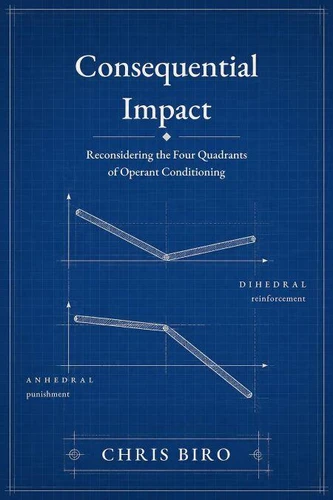
Consequential Impact. the Applied Evolutionary Ethology Series, #4
Par :Formats :
Disponible dans votre compte client Decitre ou Furet du Nord dès validation de votre commande. Le format ePub est :
- Compatible avec une lecture sur My Vivlio (smartphone, tablette, ordinateur)
- Compatible avec une lecture sur liseuses Vivlio
- Pour les liseuses autres que Vivlio, vous devez utiliser le logiciel Adobe Digital Edition. Non compatible avec la lecture sur les liseuses Kindle, Remarkable et Sony
 , qui est-ce ?
Notre partenaire de plateforme de lecture numérique où vous retrouverez l'ensemble de vos ebooks gratuitement
Pour en savoir plus sur nos ebooks, consultez notre aide en ligne ici
C'est si simple ! Lisez votre ebook avec l'app Vivlio sur votre tablette, mobile ou ordinateur :

- FormatePub
- ISBN8995808183
- EAN9798995808183
- Date de parution31/08/2026
- Protection num.pas de protection
- Infos supplémentairesepub
- ÉditeurChris Biro
Résumé
The four quadrants of operant conditioning - add or remove, increase or decrease - have organized animal training for more than sixty years. They are technically correct. They are also built from outside the animal. A consequence is what the trainer delivers. An impact is what the animal makes of it. This book recovers the missing half of that transaction: the strategic work of promoting and demoting, and a structural reason reinforcement and punishment are not mirror images.
Reinforcement is dihedral. Punishment is anhedral. The four classic side effects of punishment are the architecture's own stability solutions, not mysterious bugs. Not an argument for punishment. Not a manual for using it. An account of why the tool is unstable, how small the territory is in which it is the right one, and why a field that will not examine half its toolbox leaves practitioners to use that half badly.
Part Four of Revisiting The Behavior of Organisms - the Applied Evolutionary Ethology Series.
Reinforcement is dihedral. Punishment is anhedral. The four classic side effects of punishment are the architecture's own stability solutions, not mysterious bugs. Not an argument for punishment. Not a manual for using it. An account of why the tool is unstable, how small the territory is in which it is the right one, and why a field that will not examine half its toolbox leaves practitioners to use that half badly.
Part Four of Revisiting The Behavior of Organisms - the Applied Evolutionary Ethology Series.