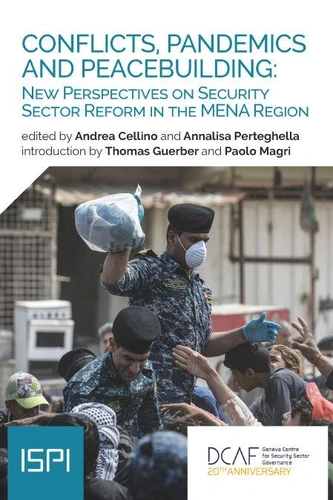
Conflicts, Pandemics and Peacebuilding. New Perspectives on Security Sector Reform in the MENA Region
Par : ,Formats :
Disponible dans votre compte client Decitre ou Furet du Nord dès validation de votre commande. Le format ePub est :
- Compatible avec une lecture sur My Vivlio (smartphone, tablette, ordinateur)
- Compatible avec une lecture sur liseuses Vivlio
- Pour les liseuses autres que Vivlio, vous devez utiliser le logiciel Adobe Digital Edition. Non compatible avec la lecture sur les liseuses Kindle, Remarkable et Sony
 , qui est-ce ?
Notre partenaire de plateforme de lecture numérique où vous retrouverez l'ensemble de vos ebooks gratuitement
Pour en savoir plus sur nos ebooks, consultez notre aide en ligne ici
C'est si simple ! Lisez votre ebook avec l'app Vivlio sur votre tablette, mobile ou ordinateur :

- Nombre de pages119
- FormatePub
- ISBN978-88-5526-393-1
- EAN9788855263931
- Date de parution18/01/2021
- Protection num.Digital Watermarking
- Taille1 Mo
- Infos supplémentairesepub
- ÉditeurLedizioni
Résumé
The Covid-19 pandemic is not only a health challenge. In the MENA region, against the backdrop of protracted conflicts, instability, and an overall deterioration in socio-economic conditions, the coronavirus crisis adds another layer of vulnerability and has already had long-lasting repercussions on human security across the region. Moreover, as hybrid actors take on an important role as security providers amid the pandemic in a context of limited or absent oversight, risks associated to a lack of accountability, ethno-religious discrimination, human rights abuses, and gender-based violence grow.
While classical approaches to security provision tend to portray non-state actors and the State as inherently at odds, the complexity of a rapidly evolving security landscape throughout the region should trigger a revision of the very concept of effective governance. Against this backdrop, how should Security Sector Reform (SSR) strategies and programmes adapt? What lessons can be drawn from selected case studies such as Iraq, Libya, and Yemen?
While classical approaches to security provision tend to portray non-state actors and the State as inherently at odds, the complexity of a rapidly evolving security landscape throughout the region should trigger a revision of the very concept of effective governance. Against this backdrop, how should Security Sector Reform (SSR) strategies and programmes adapt? What lessons can be drawn from selected case studies such as Iraq, Libya, and Yemen?