SOLDES
Jusqu'à -70% sur une sélection d'articles*

Nouveauté
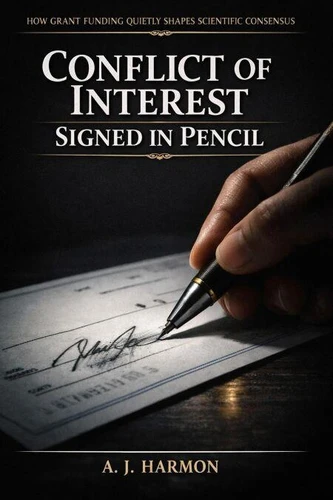
Conflict of Interest, Signed in Pencil: How Grant Funding Quietly Shapes Scientific Consensus
Par :Formats :
Disponible dans votre compte client Decitre ou Furet du Nord dès validation de votre commande. Le format ePub est :
- Compatible avec une lecture sur My Vivlio (smartphone, tablette, ordinateur)
- Compatible avec une lecture sur liseuses Vivlio
- Pour les liseuses autres que Vivlio, vous devez utiliser le logiciel Adobe Digital Edition. Non compatible avec la lecture sur les liseuses Kindle, Remarkable et Sony
 , qui est-ce ?
Notre partenaire de plateforme de lecture numérique où vous retrouverez l'ensemble de vos ebooks gratuitement
Pour en savoir plus sur nos ebooks, consultez notre aide en ligne ici
C'est si simple ! Lisez votre ebook avec l'app Vivlio sur votre tablette, mobile ou ordinateur :

- FormatePub
- ISBN8235061736
- EAN9798235061736
- Date de parution29/06/2026
- Protection num.pas de protection
- Infos supplémentairesepub
- ÉditeurIoakim Ioakim
Résumé
The evidence was always real. The researchers were not dishonest. And yet the science was wrong - because the most powerful decisions in research happen before a single experiment begins. Conflict of Interest, Signed in Pencil is the definitive account of how commercial grant funding quietly reshapes scientific truth. Not through fabricated data or corrupt laboratories, but through something far more subtle: the choice of questions that never get asked, the studies that never get funded, the findings that never reach publication, and the experts who become authorities precisely because they ask what the money wants them to ask.
A. J. Harmon spent fifteen years inside academic research institutions watching this system operate in plain sight. What emerged is a book that reads like a thriller and argues like a scholar - tracing the financial architecture behind modern science from the pharmaceutical industry's management of clinical trial evidence, to the sugar industry's successful burial of the dietary fat debate, to the tobacco playbook that every major polluting industry adopted and refined.
The trail leads through ghost-authored journal articles signed by prestigious academics, through expert guideline panels stacked with industry consultants, through regulatory agencies staffed by scientists who will return to corporate positions within months of issuing a ruling. This is not a book about bad scientists. It is a book about a system designed so that even honest scientists, working rigorously within the rules, produce a body of literature skewed toward conclusions that serve the interests funding them.
The mechanism is structural. The distortion is systematic. And the cost - measured in delayed regulation, preventable disease, and clinical decisions made on a literature that does not fully represent what was actually found - is staggering. Harmon draws on peer-reviewed meta-analyses, internal industry documents, litigation discovery records, and decades of published research on research itself. He names the mechanisms: publication bias, outcome switching, ghost authorship, the key opinion leader economy, the revolving door between regulatory agencies and the industries they oversee.
He traces the same playbook from tobacco in 1953 to social media platforms today. Conflict of Interest, Signed in Pencil is essential reading for anyone who relies on science to make decisions - which, in the modern world, is everyone. It does not argue that science cannot be trusted. It teaches you how to read it honestly, how to follow the funding, and how to see the pencil marks that were always there.
A. J. Harmon spent fifteen years inside academic research institutions watching this system operate in plain sight. What emerged is a book that reads like a thriller and argues like a scholar - tracing the financial architecture behind modern science from the pharmaceutical industry's management of clinical trial evidence, to the sugar industry's successful burial of the dietary fat debate, to the tobacco playbook that every major polluting industry adopted and refined.
The trail leads through ghost-authored journal articles signed by prestigious academics, through expert guideline panels stacked with industry consultants, through regulatory agencies staffed by scientists who will return to corporate positions within months of issuing a ruling. This is not a book about bad scientists. It is a book about a system designed so that even honest scientists, working rigorously within the rules, produce a body of literature skewed toward conclusions that serve the interests funding them.
The mechanism is structural. The distortion is systematic. And the cost - measured in delayed regulation, preventable disease, and clinical decisions made on a literature that does not fully represent what was actually found - is staggering. Harmon draws on peer-reviewed meta-analyses, internal industry documents, litigation discovery records, and decades of published research on research itself. He names the mechanisms: publication bias, outcome switching, ghost authorship, the key opinion leader economy, the revolving door between regulatory agencies and the industries they oversee.
He traces the same playbook from tobacco in 1953 to social media platforms today. Conflict of Interest, Signed in Pencil is essential reading for anyone who relies on science to make decisions - which, in the modern world, is everyone. It does not argue that science cannot be trusted. It teaches you how to read it honestly, how to follow the funding, and how to see the pencil marks that were always there.
