
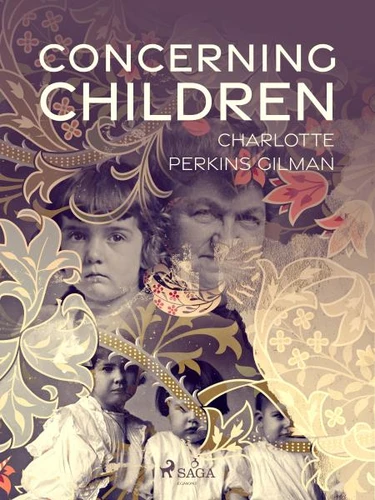
Concerning Children
Par :Formats :
Disponible dans votre compte client Decitre ou Furet du Nord dès validation de votre commande. Le format ePub est :
- Compatible avec une lecture sur My Vivlio (smartphone, tablette, ordinateur)
- Compatible avec une lecture sur liseuses Vivlio
- Pour les liseuses autres que Vivlio, vous devez utiliser le logiciel Adobe Digital Edition. Non compatible avec la lecture sur les liseuses Kindle, Remarkable et Sony
 , qui est-ce ?
Notre partenaire de plateforme de lecture numérique où vous retrouverez l'ensemble de vos ebooks gratuitement
Pour en savoir plus sur nos ebooks, consultez notre aide en ligne ici
C'est si simple ! Lisez votre ebook avec l'app Vivlio sur votre tablette, mobile ou ordinateur :

- Nombre de pages328
- FormatePub
- ISBN978-87-28-10364-7
- EAN9788728103647
- Date de parution19/07/2022
- Protection num.Digital Watermarking
- Taille481 Ko
- Infos supplémentairesepub
- ÉditeurSAGA Egmont
Résumé
´Concerning Children´, by Charlotte Perkins Gilman, was first published in 1900 and focuses on how society can be improved through better nurturing of the younger generations.
Reminiscent of Supernanny Jo Frost and Dr. Spock, Charlotte Perkins Gilman offers a surprisingly modern take on child-rearing in this influential parenting handbook, which still resonates with feminist readers today. Gilman echoes the old African proverb "It takes a village to raise a child", and considers this in the context of a patriarchal US society.
From discussions of building resilience in children to gender and obedience, Gilman manages to encompass politics, economic, and societal arguments as well as gender, sexism, and new motherhood all in one fascinating book which aims to improve the community at large. ´Concerning Children´ will delight fans of Gilman's other works such as 'The Home, Its Work and Influence'. Charlotte Perkins Gilman, also known as Charlotte Perkins Stetson, was born on 3rd July 1860 in Connecticut, USA.
Her early family life was troubled, with her father abandoning his wife and family; a move which strongly influenced her feminist political leanings and advocator of women's rights. After working as a tutor and painter, Perkins - a self-declared humanist and 'tom boy' - began to work as a writer of short stories, novels, non-fiction pieces and poetry. Her best-known work is her semi-autobiographical short story, inspired by her post-natal depression, entitled 'The Yellow Wallpaper', which was published in 1892 and made into a film in 2011.
Charlotte Perkins Gilman was a member of the American National Women's Hall of Fame and strongly believed that "the domestic environment oppressed women through the patriarchal beliefs upheld by society". A believer in euthanasia, she was diagnosed with incurable breast cancer in January 1932 and subsequently took her own life in August 1935, writing in her suicide note that she "chose chloroform over cancer".
From discussions of building resilience in children to gender and obedience, Gilman manages to encompass politics, economic, and societal arguments as well as gender, sexism, and new motherhood all in one fascinating book which aims to improve the community at large. ´Concerning Children´ will delight fans of Gilman's other works such as 'The Home, Its Work and Influence'. Charlotte Perkins Gilman, also known as Charlotte Perkins Stetson, was born on 3rd July 1860 in Connecticut, USA.
Her early family life was troubled, with her father abandoning his wife and family; a move which strongly influenced her feminist political leanings and advocator of women's rights. After working as a tutor and painter, Perkins - a self-declared humanist and 'tom boy' - began to work as a writer of short stories, novels, non-fiction pieces and poetry. Her best-known work is her semi-autobiographical short story, inspired by her post-natal depression, entitled 'The Yellow Wallpaper', which was published in 1892 and made into a film in 2011.
Charlotte Perkins Gilman was a member of the American National Women's Hall of Fame and strongly believed that "the domestic environment oppressed women through the patriarchal beliefs upheld by society". A believer in euthanasia, she was diagnosed with incurable breast cancer in January 1932 and subsequently took her own life in August 1935, writing in her suicide note that she "chose chloroform over cancer".
A propos de Charlotte Perkins Gilman
The Yellow Wallpaper
Audiobook
0,99 €
4,99 €

Die gelbe Tapete
E-book
3,99 €

The Yellow Wall-Paper
E-book
8,99 €
22,99 €

9,99 €
With Her in Ourland (Unabridged)
Audiobook
5,49 €
Moving the Mountain
E-book
1,99 €
Herland
E-book
4,99 €
Benigna Machiavelli
E-book
1,99 €

Moving The Mountain (Unabridged)
Audiobook
4,22 €
The Crux
E-book
1,99 €
The Forerunner
E-book
1,99 €
1,99 €