
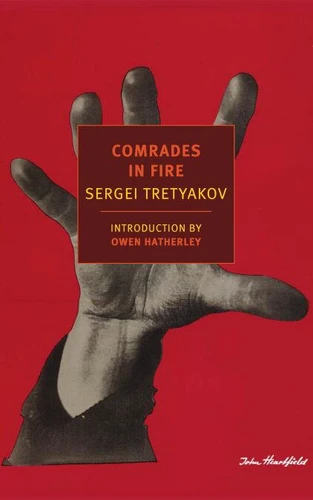
Comrades in Fire
Par : , ,Formats :
Disponible dans votre compte client Decitre ou Furet du Nord dès validation de votre commande. Le format ePub protégé est :
- Compatible avec une lecture sur My Vivlio (smartphone, tablette, ordinateur)
- Compatible avec une lecture sur liseuses Vivlio
- Pour les liseuses autres que Vivlio, vous devez utiliser le logiciel Adobe Digital Edition. Non compatible avec la lecture sur les liseuses Kindle, Remarkable et Sony
- Non compatible avec un achat hors France métropolitaine
 , qui est-ce ?
Notre partenaire de plateforme de lecture numérique où vous retrouverez l'ensemble de vos ebooks gratuitement
Pour en savoir plus sur nos ebooks, consultez notre aide en ligne ici
C'est si simple ! Lisez votre ebook avec l'app Vivlio sur votre tablette, mobile ou ordinateur :

- Nombre de pages256
- Date de parution18/05/2027
- FormatePub
- ISBN8896231424
- EAN9798896231424
- Protection num.Adobe DRM
- Infos supplémentairesepub
- ÉditeurNYRB Classics
Résumé
Vivid vignettes of life, art, and antifascism in interwar Europe by an influential (but nearly forgotten) member of the Soviet avant-garde, a friend of Bertolt Brecht, John Heartfield, and Sergei Eisenstein. Comrades in Fire is a portrait of interwar Europe by one of the most stylish and underappreciated writers of the Soviet avant-garde, the Latvian-born Sergei Tretyakov. From 1930 to 1931, Tretyakov travelled in Germany, Austria, and Denmark, meeting like-minded artists and anti-Nazi activists such as Bertolt Brecht and John Heartfield, people whose art was inextricably linked to political struggle.
They are the comrades in question whose books were about to be thrown into the public bonfire the Nazis organized after their seizure of power in the spring of 1933. Wandering around Berlin, Hamburg, Vienna, and Copenhagen, Tretyakov observes what would come to be the last years of the Weimar Republic and distills his impressions into vignettes of people and places. "The Young Communists, " one of his sketches begins, "would take my hand and put it on their smoothly combed heads: they wanted me to feel the scars left by Nazi knives." In another scene, a "sweet old lady" is serving a customer in her shop, "slowly leafing through albums filled with rampant pornographic photos." His reporter's eye is impressive, although his political acuity has its limits: condemning Germany's descent into totalitarianism, he doesn't yet realize that his own country is facing an equally tragic future.
By the time Tretyakov published his book in 1936, the German artists he wrote about were all in exile. Back in Moscow in 1937, Tretyakov himself was arrested, charged with espionage, and executed. What drives the narrative is his belief that the art of his comrades will not be destroyed. Their works did indeed survive the dark times, as did Tretyakov's own. A unique chronicle of an era, Comrades in Fire deserves to be read today as literature of fact at its best.
They are the comrades in question whose books were about to be thrown into the public bonfire the Nazis organized after their seizure of power in the spring of 1933. Wandering around Berlin, Hamburg, Vienna, and Copenhagen, Tretyakov observes what would come to be the last years of the Weimar Republic and distills his impressions into vignettes of people and places. "The Young Communists, " one of his sketches begins, "would take my hand and put it on their smoothly combed heads: they wanted me to feel the scars left by Nazi knives." In another scene, a "sweet old lady" is serving a customer in her shop, "slowly leafing through albums filled with rampant pornographic photos." His reporter's eye is impressive, although his political acuity has its limits: condemning Germany's descent into totalitarianism, he doesn't yet realize that his own country is facing an equally tragic future.
By the time Tretyakov published his book in 1936, the German artists he wrote about were all in exile. Back in Moscow in 1937, Tretyakov himself was arrested, charged with espionage, and executed. What drives the narrative is his belief that the art of his comrades will not be destroyed. Their works did indeed survive the dark times, as did Tretyakov's own. A unique chronicle of an era, Comrades in Fire deserves to be read today as literature of fact at its best.