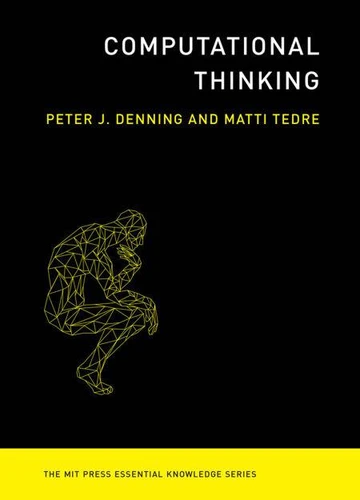
Computational Thinking
Par : ,Formats :
Disponible dans votre compte client Decitre ou Furet du Nord dès validation de votre commande. Le format ePub protégé est :
- Compatible avec une lecture sur My Vivlio (smartphone, tablette, ordinateur)
- Compatible avec une lecture sur liseuses Vivlio
- Pour les liseuses autres que Vivlio, vous devez utiliser le logiciel Adobe Digital Edition. Non compatible avec la lecture sur les liseuses Kindle, Remarkable et Sony
- Non compatible avec un achat hors France métropolitaine
 , qui est-ce ?
Notre partenaire de plateforme de lecture numérique où vous retrouverez l'ensemble de vos ebooks gratuitement
Pour en savoir plus sur nos ebooks, consultez notre aide en ligne ici
C'est si simple ! Lisez votre ebook avec l'app Vivlio sur votre tablette, mobile ou ordinateur :

- Nombre de pages264
- FormatePub
- ISBN978-0-262-35342-7
- EAN9780262353427
- Date de parution14/05/2019
- Protection num.Adobe DRM
- Taille402 Ko
- Infos supplémentairesepub
- ÉditeurThe MIT Press
Résumé
This pocket-sized introduction to computational thinking and problem-solving traces its genealogy centuries before the digital computer. A few decades into the digital era, scientists discovered that thinking in terms of computation made possible an entirely new way of organizing scientific investigation. Eventually, every field had a computational branch: computational physics, computational biology, computational sociology.
More recently, "computational thinking" has become part of the K-12 curriculum. But what is computational thinking? This volume in the MIT Press Essential Knowledge series offers an accessible overview-tracing a genealogy that begins centuries before digital computers and portraying computational thinking as the pioneers of computing have described it. The authors explain that computational thinking (CT) is not a set of concepts for programming; it is a way of thinking that is honed through practice: the mental skills for designing computations to do jobs for us, and for explaining and interpreting the world as a complex of information processes.
Mathematically trained experts (known as "computers") who performed complex calculations as teams engaged in CT long before electronic computers. In each chapter, the author identify different dimensions of today's highly developed CT:. Computational Methods. Computing Machines. Computing Education. Software Engineering. Computational Science. DesignAlong the way, they debunk inflated claims for CT and computation while making clear the power of CT in all its complexity and multiplicity.
More recently, "computational thinking" has become part of the K-12 curriculum. But what is computational thinking? This volume in the MIT Press Essential Knowledge series offers an accessible overview-tracing a genealogy that begins centuries before digital computers and portraying computational thinking as the pioneers of computing have described it. The authors explain that computational thinking (CT) is not a set of concepts for programming; it is a way of thinking that is honed through practice: the mental skills for designing computations to do jobs for us, and for explaining and interpreting the world as a complex of information processes.
Mathematically trained experts (known as "computers") who performed complex calculations as teams engaged in CT long before electronic computers. In each chapter, the author identify different dimensions of today's highly developed CT:. Computational Methods. Computing Machines. Computing Education. Software Engineering. Computational Science. DesignAlong the way, they debunk inflated claims for CT and computation while making clear the power of CT in all its complexity and multiplicity.