


Sanzaya Patel is a multidisciplinary researcher, technical author, and public-sector administrator whose work spans computational science, engineering systems, artificial intelligence, energy systems, digital twins, robotics, and Earth-system modeling. Driven by a passion for translating complex scientific concepts into practical and accessible frameworks, he has authored multiple technical works covering advanced engineering, emerging technologies, computational modeling, and AI-enabled decision systems.
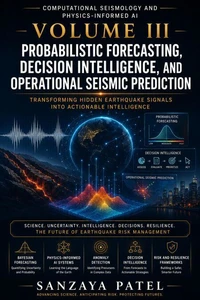
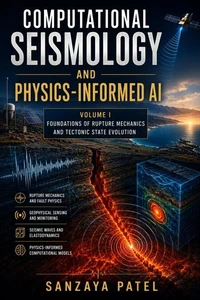
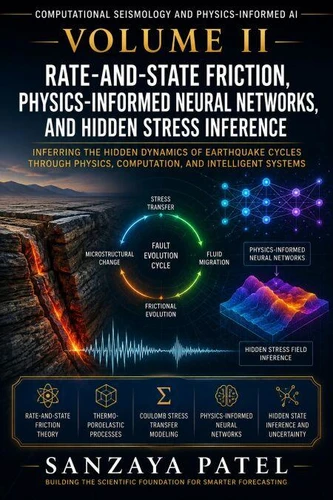
His writing emphasizes the integration of first-principles physics, mathematical rigor, computational implementation, and real-world application. In Computational Seismology and Physics-Informed AI, Patel brings together concepts from seismology, rock mechanics, fracture physics, sensing technologies, numerical simulation, and machine learning to explore the evolving frontier of earthquake science.
The series reflects a systems-thinking approach in which physical processes, computational models, and intelligent inference operate as interconnected components of a larger scientific framework. His broader research interests include digital twins, sustainable energy systems, computational engineering, intelligent infrastructure, and the application of physics-informed artificial intelligence to complex real-world problems.
Patel currently serves in academic administration while continuing independent research and technical publishing across multiple scientific and engineering domains.
His writing emphasizes the integration of first-principles physics, mathematical rigor, computational implementation, and real-world application. In Computational Seismology and Physics-Informed AI, Patel brings together concepts from seismology, rock mechanics, fracture physics, sensing technologies, numerical simulation, and machine learning to explore the evolving frontier of earthquake science.
The series reflects a systems-thinking approach in which physical processes, computational models, and intelligent inference operate as interconnected components of a larger scientific framework. His broader research interests include digital twins, sustainable energy systems, computational engineering, intelligent infrastructure, and the application of physics-informed artificial intelligence to complex real-world problems.
Patel currently serves in academic administration while continuing independent research and technical publishing across multiple scientific and engineering domains.