
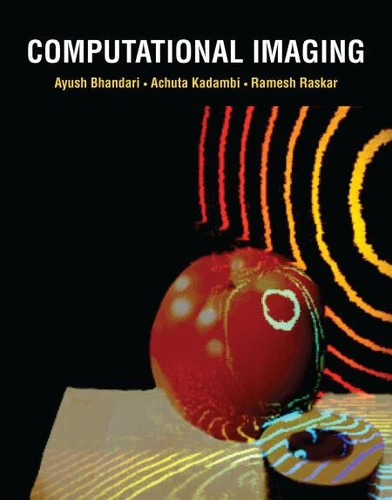
Computational Imaging
Par : , ,Formats :
Disponible dans votre compte client Decitre ou Furet du Nord dès validation de votre commande. Le format ePub protégé est :
- Compatible avec une lecture sur My Vivlio (smartphone, tablette, ordinateur)
- Compatible avec une lecture sur liseuses Vivlio
- Pour les liseuses autres que Vivlio, vous devez utiliser le logiciel Adobe Digital Edition. Non compatible avec la lecture sur les liseuses Kindle, Remarkable et Sony
- Non compatible avec un achat hors France métropolitaine
 , qui est-ce ?
Notre partenaire de plateforme de lecture numérique où vous retrouverez l'ensemble de vos ebooks gratuitement
Pour en savoir plus sur nos ebooks, consultez notre aide en ligne ici
C'est si simple ! Lisez votre ebook avec l'app Vivlio sur votre tablette, mobile ou ordinateur :

- Nombre de pages488
- FormatePub
- ISBN978-0-262-36837-7
- EAN9780262368377
- Date de parution25/10/2022
- Protection num.Adobe DRM
- Taille114 Mo
- Infos supplémentairesepub
- ÉditeurThe MIT Press
Résumé
A comprehensive and up-to-date textbook and reference for computational imaging, which combines vision, graphics, signal processing, and optics. Computational imaging involves the joint design of imaging hardware and computer algorithms to create novel imaging systems with unprecedented capabilities. In recent years such capabilities include cameras that operate at a trillion frames per second, microscopes that can see small viruses long thought to be optically irresolvable, and telescopes that capture images of black holes.
This text offers a comprehensive and up-to-date introduction to this rapidly growing field, a convergence of vision, graphics, signal processing, and optics. It can be used as an instructional resource for computer imaging courses and as a reference for professionals. It covers the fundamentals of the field, current research and applications, and light transport techniques. The text first presents an imaging toolkit, including optics, image sensors, and illumination, and a computational toolkit, introducing modeling, mathematical tools, model-based inversion, data-driven inversion techniques, and hybrid inversion techniques.
It then examines different modalities of light, focusing on the plenoptic function, which describes degrees of freedom of a light ray. Finally, the text outlines light transport techniques, describing imaging systems that obtain micron-scale 3D shape or optimize for noise-free imaging, optical computing, and non-line-of-sight imaging. Throughout, it discusses the use of computational imaging methods in a range of application areas, including smart phone photography, autonomous driving, and medical imaging.
End-of-chapter exercises help put the material in context.
This text offers a comprehensive and up-to-date introduction to this rapidly growing field, a convergence of vision, graphics, signal processing, and optics. It can be used as an instructional resource for computer imaging courses and as a reference for professionals. It covers the fundamentals of the field, current research and applications, and light transport techniques. The text first presents an imaging toolkit, including optics, image sensors, and illumination, and a computational toolkit, introducing modeling, mathematical tools, model-based inversion, data-driven inversion techniques, and hybrid inversion techniques.
It then examines different modalities of light, focusing on the plenoptic function, which describes degrees of freedom of a light ray. Finally, the text outlines light transport techniques, describing imaging systems that obtain micron-scale 3D shape or optimize for noise-free imaging, optical computing, and non-line-of-sight imaging. Throughout, it discusses the use of computational imaging methods in a range of application areas, including smart phone photography, autonomous driving, and medical imaging.
End-of-chapter exercises help put the material in context.