
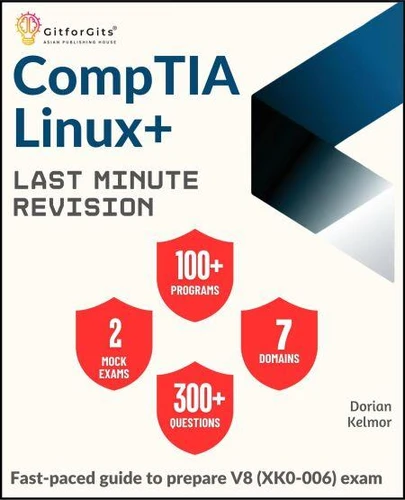
CompTIA Linux+ Last Minute Revision
Par :Formats :
Disponible dans votre compte client Decitre ou Furet du Nord dès validation de votre commande. Le format ePub protégé est :
- Compatible avec une lecture sur My Vivlio (smartphone, tablette, ordinateur)
- Compatible avec une lecture sur liseuses Vivlio
- Pour les liseuses autres que Vivlio, vous devez utiliser le logiciel Adobe Digital Edition. Non compatible avec la lecture sur les liseuses Kindle, Remarkable et Sony
- Non compatible avec un achat hors France métropolitaine
 , qui est-ce ?
Notre partenaire de plateforme de lecture numérique où vous retrouverez l'ensemble de vos ebooks gratuitement
Pour en savoir plus sur nos ebooks, consultez notre aide en ligne ici
C'est si simple ! Lisez votre ebook avec l'app Vivlio sur votre tablette, mobile ou ordinateur :

- FormatePub
- ISBN8232162504
- EAN9798232162504
- Date de parution31/10/2025
- Protection num.Adobe DRM
- Infos supplémentairesepub
- ÉditeurDraft2Digital
Résumé
For those of you who need to get ready for your CompTIA Linux+ exam in a hurry, this book is exactly what you need. This book's got a bunch of practical tasks and focused revision to help you feel ready for your test. Every chapter is based around exam objectives and covers essential skills through step-by-step, scenario-based activities. To start with, you will be working on recovering systems from GRUB prompts, fixing bootloader issues, and managing kernel modules.
All the essential tasks, like handling file systems, logical volumes, RAID arrays and NFS mounts, are broken down into clear, easy-to-follow recipes. There'll be plenty of practice in user and group management, permissions, access control lists and troubleshooting login and authentication issues. It covers automation techniques with Bash and Python, helping you script daily operations and validate system states.
There are some great practical activities that will take you through repairing repositories, managing packages and system updates, so you'll be all set to handle real-world Linux administration. Topics like networking, service management, firewall configuration and DNS troubleshooting are taught through hands-on exercises. The security section covers things like account hygiene, SELinux and AppArmor controls, and key audit tasks.
It covers modern infrastructure skills too, with hands-on chapters on containers, virtualisation, Ansible, Git, and cloud-init for automated provisioning. Every chapter ends with some practice questions that are based on the sort of stuff you might be asked in the CompTIA Linux+ exam, and the book finishes with two full mock exams to help you work out how ready you are. Table of Content Boot Rescue and Service Startup Filesystems, Mounts, LVM and RAID Users, Groups, Permissions and PAM Packages, Repositories and Scheduling Networking and Name Services Host Security, SELinux or AppArmor and Firewalls Shell Scripting and Tiny Python Utilities Ansible and Git for Ops Troubleshooting and Observability Containers, Virtual Machines and Cloud-Init Mock Exam - Set 'A' Mock Exam - Set 'B'
All the essential tasks, like handling file systems, logical volumes, RAID arrays and NFS mounts, are broken down into clear, easy-to-follow recipes. There'll be plenty of practice in user and group management, permissions, access control lists and troubleshooting login and authentication issues. It covers automation techniques with Bash and Python, helping you script daily operations and validate system states.
There are some great practical activities that will take you through repairing repositories, managing packages and system updates, so you'll be all set to handle real-world Linux administration. Topics like networking, service management, firewall configuration and DNS troubleshooting are taught through hands-on exercises. The security section covers things like account hygiene, SELinux and AppArmor controls, and key audit tasks.
It covers modern infrastructure skills too, with hands-on chapters on containers, virtualisation, Ansible, Git, and cloud-init for automated provisioning. Every chapter ends with some practice questions that are based on the sort of stuff you might be asked in the CompTIA Linux+ exam, and the book finishes with two full mock exams to help you work out how ready you are. Table of Content Boot Rescue and Service Startup Filesystems, Mounts, LVM and RAID Users, Groups, Permissions and PAM Packages, Repositories and Scheduling Networking and Name Services Host Security, SELinux or AppArmor and Firewalls Shell Scripting and Tiny Python Utilities Ansible and Git for Ops Troubleshooting and Observability Containers, Virtual Machines and Cloud-Init Mock Exam - Set 'A' Mock Exam - Set 'B'