Avocat à la Cour d'appel de Paris et ingénieur diplômé de l'Ecole Spéciale des Travaux publics, du bâtiment et de l'industrie, directeur département Technologies Emergentes ALAIN BENSOUSSAN AVOCATS.
Chairman of Robolution Capital.
European Parliament Deputy, Chairperson of the Committee on Legal Affairs.
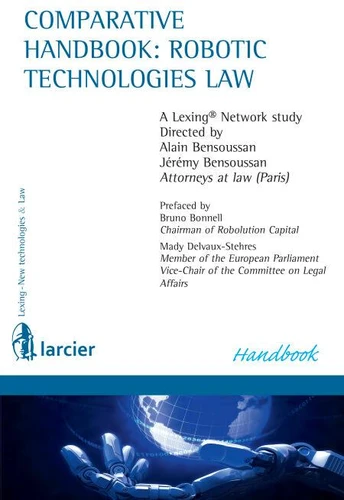
Comparative handbook : robotic technologies law. A Lexing Network study
Par : ,Formats :
Disponible dans votre compte client Decitre ou Furet du Nord dès validation de votre commande. Le format ePub est :
- Compatible avec une lecture sur My Vivlio (smartphone, tablette, ordinateur)
- Compatible avec une lecture sur liseuses Vivlio
- Pour les liseuses autres que Vivlio, vous devez utiliser le logiciel Adobe Digital Edition. Non compatible avec la lecture sur les liseuses Kindle, Remarkable et Sony
 , qui est-ce ?
Notre partenaire de plateforme de lecture numérique où vous retrouverez l'ensemble de vos ebooks gratuitement
Pour en savoir plus sur nos ebooks, consultez notre aide en ligne ici
C'est si simple ! Lisez votre ebook avec l'app Vivlio sur votre tablette, mobile ou ordinateur :

- FormatePub
- ISBN978-2-8044-9177-2
- EAN9782804491772
- Date de parution28/06/2016
- Protection num.pas de protection
- Infos supplémentairesepub
- ÉditeurÉditions Larcier
- PréfacierBruno Bonnell
- PréfacierMady Delvaux-Stehres
Résumé
Studies of the overall impact of robotics on the economy have shown that investments in its various sectors - industrial, professional and service robotics - are increasing globally and the markets associated with them are valued in billions. Robotization improves the competitiveness of enterprises, while collaborative robotics reinvents methods of production. Beyond the economic outlook, service robotics, backed by the development of artificial intelligence, raises challenging ethical and social issues.
The legal analysis of robotics is no mean feat because it covers a very diverse technical reality. Companies whose businesses are focused on robotic technologies and applications can be confronted with a complex legal situation resulting from the plurality of the applicable rules which have not necessarily been conceived or adopted bearing in mind their specific constraints. This situation should not hamper their development.
It only implies taking cues from the economic legal norms which promote such developments and conducting an analysis of the legal risks which they face, given the applicable rules of liability. This comparative study - carried out by members of the Lexing® Network - proposes an overview, having regard to the legislation of 17 different countries, of the legal issues raised by robotics and the way the law in force responds, in a more or less satisfactory manner.
Discover the authors & contributors in details under the tab 'Extraits'.
The legal analysis of robotics is no mean feat because it covers a very diverse technical reality. Companies whose businesses are focused on robotic technologies and applications can be confronted with a complex legal situation resulting from the plurality of the applicable rules which have not necessarily been conceived or adopted bearing in mind their specific constraints. This situation should not hamper their development.
It only implies taking cues from the economic legal norms which promote such developments and conducting an analysis of the legal risks which they face, given the applicable rules of liability. This comparative study - carried out by members of the Lexing® Network - proposes an overview, having regard to the legislation of 17 different countries, of the legal issues raised by robotics and the way the law in force responds, in a more or less satisfactory manner.
Discover the authors & contributors in details under the tab 'Extraits'.
A propos de Alain Bensoussan

43,00 €
59,99 €
Code de la sécurité informatique et télécom
Grand Format
100,00 €

12,00 €

78,00 €


Informatique et libertés
3e édition
3e édition
Grand Format
139,00 €