SOLDES
Jusqu'à -70% sur une sélection d'articles*

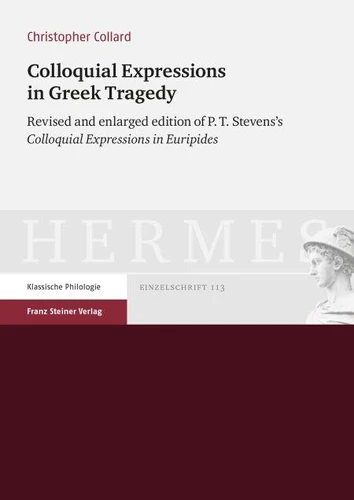
Colloquial Expressions in Greek Tragedy. Revised and enlarged edition of P.T. Stevens's "Colloquial Expressions in Euripides"
Par : ,Formats :
Disponible dans votre compte client Decitre ou Furet du Nord dès validation de votre commande. Le format PDF est :
- Compatible avec une lecture sur My Vivlio (smartphone, tablette, ordinateur)
- Compatible avec une lecture sur liseuses Vivlio
- Pour les liseuses autres que Vivlio, vous devez utiliser le logiciel Adobe Digital Edition. Non compatible avec la lecture sur les liseuses Kindle, Remarkable et Sony
 , qui est-ce ?
Notre partenaire de plateforme de lecture numérique où vous retrouverez l'ensemble de vos ebooks gratuitement
Pour en savoir plus sur nos ebooks, consultez notre aide en ligne ici
C'est si simple ! Lisez votre ebook avec l'app Vivlio sur votre tablette, mobile ou ordinateur :

- Nombre de pages255
- FormatPDF
- ISBN978-3-515-12056-2
- EAN9783515120562
- Date de parution25/10/2018
- Protection num.Digital Watermarking
- Taille3 Mo
- Infos supplémentairespdf
- ÉditeurFranz Steiner
Résumé
Stevens began identifying and collecting colloquialisms in Tragedy in 1937, refined his definitions in 1945 and finished his work with the monograph upon Euripides of 1976. This revised and enlarged edition assesses the contribution to the field by subsequent scholars. It adds many expressions to Stevens's list, which is now divided into two categories: expressions that are confidently identified as colloquial, and almost as many that are probable or possible.
An unexpected finding is that Sophocles used hardly fewer such expressions than Euripides. The e-book's chief aim is to broaden the evidential basis for colloquialisms in Tragedy, and to attempt a more useful evaluation of their usage: statistics are gathered on their distribution and location, and their frequent concentration in types of dramatic and stylistic context. Many individual passages, and the possible use of colloquialisms for characterization, are discussed.
The e-book includes full indices locorum for expressions and usages.
An unexpected finding is that Sophocles used hardly fewer such expressions than Euripides. The e-book's chief aim is to broaden the evidential basis for colloquialisms in Tragedy, and to attempt a more useful evaluation of their usage: statistics are gathered on their distribution and location, and their frequent concentration in types of dramatic and stylistic context. Many individual passages, and the possible use of colloquialisms for characterization, are discussed.
The e-book includes full indices locorum for expressions and usages.