
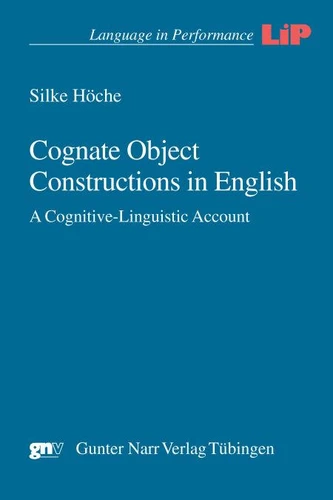
Cognate Object Constructions in English. A Cognitive-Linguistic Account
Par :Formats :
Disponible dans votre compte client Decitre ou Furet du Nord dès validation de votre commande. Le format PDF est :
- Compatible avec une lecture sur My Vivlio (smartphone, tablette, ordinateur)
- Compatible avec une lecture sur liseuses Vivlio
- Pour les liseuses autres que Vivlio, vous devez utiliser le logiciel Adobe Digital Edition. Non compatible avec la lecture sur les liseuses Kindle, Remarkable et Sony
 , qui est-ce ?
Notre partenaire de plateforme de lecture numérique où vous retrouverez l'ensemble de vos ebooks gratuitement
Pour en savoir plus sur nos ebooks, consultez notre aide en ligne ici
C'est si simple ! Lisez votre ebook avec l'app Vivlio sur votre tablette, mobile ou ordinateur :

- Nombre de pages311
- FormatPDF
- ISBN978-3-8233-7489-3
- EAN9783823374893
- Date de parution20/05/2009
- Protection num.Digital Watermarking
- Taille1 Mo
- Infos supplémentairespdf
- ÉditeurGunter Narr Verlag
Résumé
"Cognate Object Constructions in English." is the first comprehensive description of linguistic expressions such as Both died an unheroic death or Jamie grinned his tired grin, viewed from a Cognitive Linguistic perspective. Redefining the category of "cognate objects", the book provides a systematic account of prototypical and less prototypical instances of this pattern. Based on real-usage data from the BNC, the study presents a family of constructions which are equipped with their own syntactic and lexical idiosyncrasies and their own semantic-pragmatic functions, such as event structuring and event intensification.
In a step-by-step fashion, the author develops a network of constructional schemas ranging from abstract to concrete, thereby investigating and corroborating the plausibility of a lexis-syntax continuum - one of the main assumptions of the Cognitive Linguistics enterprise. The book offers important insight on concepts such as argument structure and transitivity and demonstrates the fruitful interrelationship between Cognitive Linguistics and statistical corpus linguistics.
In a step-by-step fashion, the author develops a network of constructional schemas ranging from abstract to concrete, thereby investigating and corroborating the plausibility of a lexis-syntax continuum - one of the main assumptions of the Cognitive Linguistics enterprise. The book offers important insight on concepts such as argument structure and transitivity and demonstrates the fruitful interrelationship between Cognitive Linguistics and statistical corpus linguistics.