
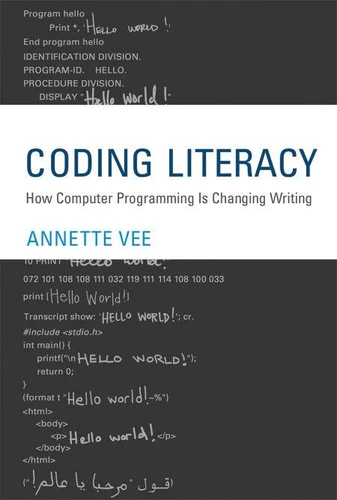
Coding Literacy. How Computer Programming Is Changing Writing
Par :Formats :
Disponible dans votre compte client Decitre ou Furet du Nord dès validation de votre commande. Le format ePub protégé est :
- Compatible avec une lecture sur My Vivlio (smartphone, tablette, ordinateur)
- Compatible avec une lecture sur liseuses Vivlio
- Pour les liseuses autres que Vivlio, vous devez utiliser le logiciel Adobe Digital Edition. Non compatible avec la lecture sur les liseuses Kindle, Remarkable et Sony
- Non compatible avec un achat hors France métropolitaine
 , qui est-ce ?
Notre partenaire de plateforme de lecture numérique où vous retrouverez l'ensemble de vos ebooks gratuitement
Pour en savoir plus sur nos ebooks, consultez notre aide en ligne ici
C'est si simple ! Lisez votre ebook avec l'app Vivlio sur votre tablette, mobile ou ordinateur :

- Nombre de pages376
- FormatePub
- ISBN978-0-262-34024-3
- EAN9780262340243
- Date de parution28/07/2017
- Protection num.Adobe DRM
- Taille2 Mo
- Infos supplémentairesepub
- ÉditeurThe MIT Press
Résumé
How the theoretical tools of literacy help us understand programming in its historical, social and conceptual contexts. The message from educators, the tech community, and even politicians is clear: everyone should learn to code. To emphasize the universality and importance of computer programming, promoters of coding for everyone often invoke the concept of "literacy, " drawing parallels between reading and writing code and reading and writing text.
In this book, Annette Vee examines the coding-as-literacy analogy and argues that it can be an apt rhetorical frame. The theoretical tools of literacy help us understand programming beyond a technical level, and in its historical, social, and conceptual contexts. Viewing programming from the perspective of literacy and literacy from the perspective of programming, she argues, shifts our understandings of both.
Computer programming becomes part of an array of communication skills important in everyday life, and literacy, augmented by programming, becomes more capacious. Vee examines the ways that programming is linked with literacy in coding literacy campaigns, considering the ideologies that accompany this coupling, and she looks at how both writing and programming encode and distribute information. She explores historical parallels between writing and programming, using the evolution of mass textual literacy to shed light on the trajectory of code from military and government infrastructure to large-scale businesses to personal use.
Writing and coding were institutionalized, domesticated, and then established as a basis for literacy. Just as societies demonstrated a "literate mentality" regardless of the literate status of individuals, Vee argues, a "computational mentality" is now emerging even though coding is still a specialized skill.
In this book, Annette Vee examines the coding-as-literacy analogy and argues that it can be an apt rhetorical frame. The theoretical tools of literacy help us understand programming beyond a technical level, and in its historical, social, and conceptual contexts. Viewing programming from the perspective of literacy and literacy from the perspective of programming, she argues, shifts our understandings of both.
Computer programming becomes part of an array of communication skills important in everyday life, and literacy, augmented by programming, becomes more capacious. Vee examines the ways that programming is linked with literacy in coding literacy campaigns, considering the ideologies that accompany this coupling, and she looks at how both writing and programming encode and distribute information. She explores historical parallels between writing and programming, using the evolution of mass textual literacy to shed light on the trajectory of code from military and government infrastructure to large-scale businesses to personal use.
Writing and coding were institutionalized, domesticated, and then established as a basis for literacy. Just as societies demonstrated a "literate mentality" regardless of the literate status of individuals, Vee argues, a "computational mentality" is now emerging even though coding is still a specialized skill.