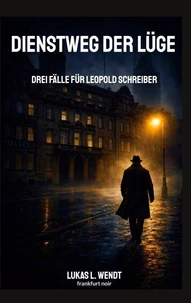
Close Enough. Leopold Schreiber's Later Cases
Par :Formats :
Disponible dans votre compte client Decitre ou Furet du Nord dès validation de votre commande. Le format ePub est :
- Compatible avec une lecture sur My Vivlio (smartphone, tablette, ordinateur)
- Compatible avec une lecture sur liseuses Vivlio
- Pour les liseuses autres que Vivlio, vous devez utiliser le logiciel Adobe Digital Edition. Non compatible avec la lecture sur les liseuses Kindle, Remarkable et Sony
 , qui est-ce ?
Notre partenaire de plateforme de lecture numérique où vous retrouverez l'ensemble de vos ebooks gratuitement
Pour en savoir plus sur nos ebooks, consultez notre aide en ligne ici
C'est si simple ! Lisez votre ebook avec l'app Vivlio sur votre tablette, mobile ou ordinateur :

- Nombre de pages272
- FormatePub
- ISBN978-3-6957-9521-5
- EAN9783695795215
- Date de parution16/03/2026
- Protection num.Digital Watermarking
- Taille595 Ko
- Infos supplémentairesepub
- ÉditeurBoD - Books on Demand
Résumé
Frankfurt likes simple answers.
When a crime happens, a story is built. It sounds reasonable. It fits what people already believe. The file is closed, and the city moves on.
Leopold Schreiber does not.
Retired and without a badge, Schreiber no longer has the pressure to finish things neatly. He only has time, and a sharp sense for when an explanation comes too easily.
Close Enough collects three cases from Schreiber's later years.
A violent death. A medical tragedy. A truth too damaging to prove. On paper, the procedures were followed and the reports are clean. Everyone did their job. That is exactly what makes them dangerous. From the pharmacies of Nordend to the backrooms of Sachsenhausen, Schreiber looks at what was ignored rather than what was hidden. These are stories about how institutions protect themselves, and how a truth can exist without ever becoming official. Some cases are solved.
Some are closed. And some are just close enough.
A violent death. A medical tragedy. A truth too damaging to prove. On paper, the procedures were followed and the reports are clean. Everyone did their job. That is exactly what makes them dangerous. From the pharmacies of Nordend to the backrooms of Sachsenhausen, Schreiber looks at what was ignored rather than what was hidden. These are stories about how institutions protect themselves, and how a truth can exist without ever becoming official. Some cases are solved.
Some are closed. And some are just close enough.