Tessa Brandt has spent eleven years inside Paladin Shield Technologies - a defense contractor in Arlington, Virginia - protecting classified systems for the Department of Defense. She is meticulous, principled, and the best cybersecurity engineer the company has ever employed. Her badge is her identity. Her audit checklist is her religion. The system works, and she is its most devoted servant. Then the system turns on her.
During a routine security audit of the Aegis Integrated Defense Platform - a billion-dollar architecture sold to the Pentagon as impenetrable - Tessa discovers something that shouldn't exist: an undocumented pathway hidden in the system's foundation. A digital door where the blueprints show a wall. Within days of flagging the anomaly, her personnel file begins to change. A psychological evaluation she never underwent appears, dated during a week she was verifiably out of state.
An incident report describes a confrontation that never happened. A supervisor's observation note references a meeting that never occurred. Someone with high-level clearance is constructing a version of Tessa on paper - unstable, paranoid, unfit - designed to be believed over the woman herself. As her access is stripped away piece by piece - badge failures, escort requirements, read-only permissions, administrative leave - Tessa uncovers something far more disturbing than corporate retaliation.
The clinical language in her fabricated evaluation is identical, word for word, to the evaluation that destroyed her father's military career thirty years earlier. The same methodology. The same psychologist's name. The same institutional weapon, refined through decades of use and deployed against anyone who finds what they're not supposed to find. With her clearance suspended, her colleagues silenced by a no-contact order, and a fitness-for-duty evaluation designed to complete her destruction, Tessa must build her case from outside the building that was once her home - armed with legal pads, a prepaid phone, and the stubborn precision of a woman who refuses to become the paper version of herself.
What she finds reaches far beyond one company and one contract. Behind the door she discovered lies five years of unauthorized access to Pentagon networks - corporate espionage disguised as cybersecurity, protected by a system that destroys anyone who looks too closely. Classified Personnel is a taut, cerebral thriller about institutional power, bureaucratic violence, and the terrifying fragility of identity in a world where a signature on the wrong document is more lethal than a weapon.
It asks a question with no comfortable answer: when the system that is supposed to protect you is the system you need protection from, who do you trust?The answer is no one. Until you find the people who chose conscience over compliance.
Tessa Brandt has spent eleven years inside Paladin Shield Technologies - a defense contractor in Arlington, Virginia - protecting classified systems for the Department of Defense. She is meticulous, principled, and the best cybersecurity engineer the company has ever employed. Her badge is her identity. Her audit checklist is her religion. The system works, and she is its most devoted servant. Then the system turns on her.
During a routine security audit of the Aegis Integrated Defense Platform - a billion-dollar architecture sold to the Pentagon as impenetrable - Tessa discovers something that shouldn't exist: an undocumented pathway hidden in the system's foundation. A digital door where the blueprints show a wall. Within days of flagging the anomaly, her personnel file begins to change. A psychological evaluation she never underwent appears, dated during a week she was verifiably out of state.
An incident report describes a confrontation that never happened. A supervisor's observation note references a meeting that never occurred. Someone with high-level clearance is constructing a version of Tessa on paper - unstable, paranoid, unfit - designed to be believed over the woman herself. As her access is stripped away piece by piece - badge failures, escort requirements, read-only permissions, administrative leave - Tessa uncovers something far more disturbing than corporate retaliation.
The clinical language in her fabricated evaluation is identical, word for word, to the evaluation that destroyed her father's military career thirty years earlier. The same methodology. The same psychologist's name. The same institutional weapon, refined through decades of use and deployed against anyone who finds what they're not supposed to find. With her clearance suspended, her colleagues silenced by a no-contact order, and a fitness-for-duty evaluation designed to complete her destruction, Tessa must build her case from outside the building that was once her home - armed with legal pads, a prepaid phone, and the stubborn precision of a woman who refuses to become the paper version of herself.
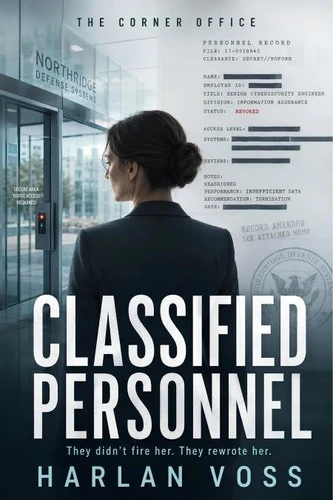
What she finds reaches far beyond one company and one contract. Behind the door she discovered lies five years of unauthorized access to Pentagon networks - corporate espionage disguised as cybersecurity, protected by a system that destroys anyone who looks too closely. Classified Personnel is a taut, cerebral thriller about institutional power, bureaucratic violence, and the terrifying fragility of identity in a world where a signature on the wrong document is more lethal than a weapon.
It asks a question with no comfortable answer: when the system that is supposed to protect you is the system you need protection from, who do you trust?The answer is no one. Until you find the people who chose conscience over compliance.


 , qui est-ce ?