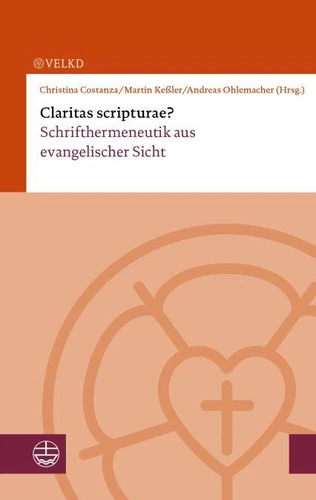
Claritas scripturae. Schrifthermeneutik aus evangelischer Sicht
Par : , ,Formats :
Disponible dans votre compte client Decitre ou Furet du Nord dès validation de votre commande. Le format PDF est :
- Compatible avec une lecture sur My Vivlio (smartphone, tablette, ordinateur)
- Compatible avec une lecture sur liseuses Vivlio
- Pour les liseuses autres que Vivlio, vous devez utiliser le logiciel Adobe Digital Edition. Non compatible avec la lecture sur les liseuses Kindle, Remarkable et Sony
 , qui est-ce ?
Notre partenaire de plateforme de lecture numérique où vous retrouverez l'ensemble de vos ebooks gratuitement
Pour en savoir plus sur nos ebooks, consultez notre aide en ligne ici
C'est si simple ! Lisez votre ebook avec l'app Vivlio sur votre tablette, mobile ou ordinateur :

- Nombre de pages280
- FormatPDF
- ISBN978-3-374-06647-6
- EAN9783374066476
- Date de parution04/01/2021
- Protection num.Digital Watermarking
- Taille3 Mo
- Infos supplémentairespdf
- ÉditeurEvangelische Verlagsanstalt
Résumé
Die "Klarheit der Heiligen Schrift" ist nicht selbstverständlich gegeben. Zugleich ist es protestantisches Grundanliegen, christliche Existenz auf "der Schrift" aufzubauen. Jahrhunderte historisch-kritischer Exegese haben zu vertieftem und tragfähigerem Verständnis geführt - und zu Herausforderungen. Hermeneutische Konzepte - auch aus Philosophie, Psychologie sowie den Literatur- und Kulturwissenschaften - bieten vielfältige Ansätze für ein zeitgemäßes Verständnis der Schriftbindung, ohne Engführungen zu folgen oder Glaubensgehalte aufzugeben.
Diesen Ansätzen haben sich auf Einladung der Vereinigten Evangelisch-lutherischen Kirche Deutschlands (VELKD) 16 Nachwuchswissenschaftlerinnen und -wissenschaftler aus zehn Fakultäten und vier Ländern sowie ein begleitender Professor gewidmet.
Konzepte von Martin Luther über Martin Heidegger bis zu Ulrich Barth und Ulrich H. J. Körtner wurden geprüft. Entstanden ist eine Kombination von Zugängen, die gerade in ihrer Interdisziplinarität und Verschiedenheit zeigt, dass es sich lohnt, weiter nach der "Klarheit der Schrift" zu fragen. [Claritas scripturae? Protestant Perspectives on the Hermeneutics of Scripture] Martin Luther's axiom of the "clarity of scripture" today seems to be gone.
Still it is part of protestant identity and "mission" to build Christian existence on scripture. Centuries of academic exegesis, especially the application of historical-critical methods, have deepened and improved the understanding of biblical texts - and did raise further challenges. "Loans" from philosophy and psychology, from literary and cultural studies did add to contemporary options of understanding, neither following too narrow paths nor hastily giving up elements of faith. Invited by the United Lutheran Church of Germany 16 junior academic theologians and a professor of church history as mentor, coming from ten faculties of theology in four countries, have joined to examine concepts from Martin Luther and Martin Heidegger to Ulrich Barth and Ulrich H.
J. Körtner, and to apply insights provided by current exegetical debates as well as those from the aesthetics of reception and from church history. The interdisciplinary and diverse approach underlined that it is still highly worthwhile to search for the highest possible "clarity of scripture".
Konzepte von Martin Luther über Martin Heidegger bis zu Ulrich Barth und Ulrich H. J. Körtner wurden geprüft. Entstanden ist eine Kombination von Zugängen, die gerade in ihrer Interdisziplinarität und Verschiedenheit zeigt, dass es sich lohnt, weiter nach der "Klarheit der Schrift" zu fragen. [Claritas scripturae? Protestant Perspectives on the Hermeneutics of Scripture] Martin Luther's axiom of the "clarity of scripture" today seems to be gone.
Still it is part of protestant identity and "mission" to build Christian existence on scripture. Centuries of academic exegesis, especially the application of historical-critical methods, have deepened and improved the understanding of biblical texts - and did raise further challenges. "Loans" from philosophy and psychology, from literary and cultural studies did add to contemporary options of understanding, neither following too narrow paths nor hastily giving up elements of faith. Invited by the United Lutheran Church of Germany 16 junior academic theologians and a professor of church history as mentor, coming from ten faculties of theology in four countries, have joined to examine concepts from Martin Luther and Martin Heidegger to Ulrich Barth and Ulrich H.
J. Körtner, and to apply insights provided by current exegetical debates as well as those from the aesthetics of reception and from church history. The interdisciplinary and diverse approach underlined that it is still highly worthwhile to search for the highest possible "clarity of scripture".