
Claudia Beltrão da Rosa is Professor of Ancient History at the Universidade Federal do Estado do Rio de Janeiro (UNIRIO).
Federico Santangelo is Professor of Ancient History at Newcastle University.
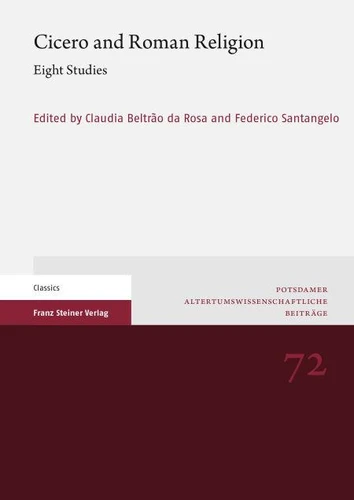
Cicero and Roman Religion. Eight Studies
Par : ,Formats :
Disponible dans votre compte client Decitre ou Furet du Nord dès validation de votre commande. Le format PDF est :
- Compatible avec une lecture sur My Vivlio (smartphone, tablette, ordinateur)
- Compatible avec une lecture sur liseuses Vivlio
- Pour les liseuses autres que Vivlio, vous devez utiliser le logiciel Adobe Digital Edition. Non compatible avec la lecture sur les liseuses Kindle, Remarkable et Sony
 , qui est-ce ?
Notre partenaire de plateforme de lecture numérique où vous retrouverez l'ensemble de vos ebooks gratuitement
Pour en savoir plus sur nos ebooks, consultez notre aide en ligne ici
C'est si simple ! Lisez votre ebook avec l'app Vivlio sur votre tablette, mobile ou ordinateur :

- Nombre de pages154
- FormatPDF
- ISBN978-3-515-12644-1
- EAN9783515126441
- Date de parution23/04/2020
- Protection num.Digital Watermarking
- Taille3 Mo
- Infos supplémentairespdf
- ÉditeurFranz Steiner
Résumé
This e-book gathers eight papers devoted to specific aspects of Cicero's engagement with Roman religion, and seeks to make a wider contribution to the understanding of Cicero's work as historical evidence. By engaging with religion as a fundamental factor of social cohesion and political stability, both in his theoretical works and his speeches, Cicero shaped a wide-ranging and ambitious discourse around themes and images that were firmly located in first-century BCE Rome.
His contribution also proved very influential in the centuries to come. The volume focuses on the relationship between law, religion, and religious authority in Cicero; the interplay between divine images, ritual contexts, and the conceptualization of the divine; Cicero's construction of a Greek deity for a Roman audience; the role of religious elements in the shaping of a Roman political identity; the tension between 'natural law' and Roman pietas; the problem of divine and human foresight; the relationship between theoretical views of the gods and late Republican public cult; and the reception, use, and readaptation of Ciceronian theology in the English Enlightenment.
His contribution also proved very influential in the centuries to come. The volume focuses on the relationship between law, religion, and religious authority in Cicero; the interplay between divine images, ritual contexts, and the conceptualization of the divine; Cicero's construction of a Greek deity for a Roman audience; the role of religious elements in the shaping of a Roman political identity; the tension between 'natural law' and Roman pietas; the problem of divine and human foresight; the relationship between theoretical views of the gods and late Republican public cult; and the reception, use, and readaptation of Ciceronian theology in the English Enlightenment.