SOLDES
Jusqu'à -70% sur une sélection d'articles*

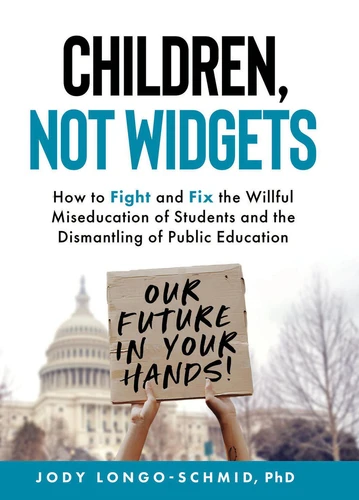
Children, Not Widgets: How to Fight and Fix the Willful Miseducation of Students and the Dismantling of Public Education
Par :Formats :
Disponible dans votre compte client Decitre ou Furet du Nord dès validation de votre commande. Le format ePub est :
- Compatible avec une lecture sur My Vivlio (smartphone, tablette, ordinateur)
- Compatible avec une lecture sur liseuses Vivlio
- Pour les liseuses autres que Vivlio, vous devez utiliser le logiciel Adobe Digital Edition. Non compatible avec la lecture sur les liseuses Kindle, Remarkable et Sony
 , qui est-ce ?
Notre partenaire de plateforme de lecture numérique où vous retrouverez l'ensemble de vos ebooks gratuitement
Pour en savoir plus sur nos ebooks, consultez notre aide en ligne ici
C'est si simple ! Lisez votre ebook avec l'app Vivlio sur votre tablette, mobile ou ordinateur :

- FormatePub
- ISBN978-1-7377385-2-7
- EAN9781737738527
- Date de parution23/05/2022
- Protection num.pas de protection
- Infos supplémentairesepub
- ÉditeurEmerald Calabria, LLC
Résumé
Through the analysis of congressional debates and hearings, presidential speeches, public opinion polls, and eighty-three interviews with administrators and teachers, Children, Not Widgets shows how policymakers willfully unraveled many public services, like education. The framing of government as the problem, rather than the solution, and citizens as consumers, rather than community members, justified allotting public resources to an unregulated private sector.
Over time, the claim that markets would better achieve important social democratic ends-such as increased civic engagement and socio-economic integration-as economic growth trickled down in ways that would "lift all boats" created what some have referred to as a consumerocracy, where public services are evaluated based on how well they serve individual wants versus collective ends. The book elaborates on why the construction of education as a good that is produced by teachers and consumed by individuals-versus a good that is produced collectively for the benefit of society-jeopardizes the broader benefits provided through a strong system of public education, and how the resulting market-based reforms resulted in unequal, unproductive, and undemocratic outcomes.
By juxtaposing policymakers' views with those of educators, the book maps a broad-based policy agenda that addresses the social, economic, and political contexts of schools-not just the behaviors of individual educators, parents, and students-to promote equity, foster the broader social democratic and transformative ends of public schools, and provide choice while still improving public education for all children.
Over time, the claim that markets would better achieve important social democratic ends-such as increased civic engagement and socio-economic integration-as economic growth trickled down in ways that would "lift all boats" created what some have referred to as a consumerocracy, where public services are evaluated based on how well they serve individual wants versus collective ends. The book elaborates on why the construction of education as a good that is produced by teachers and consumed by individuals-versus a good that is produced collectively for the benefit of society-jeopardizes the broader benefits provided through a strong system of public education, and how the resulting market-based reforms resulted in unequal, unproductive, and undemocratic outcomes.
By juxtaposing policymakers' views with those of educators, the book maps a broad-based policy agenda that addresses the social, economic, and political contexts of schools-not just the behaviors of individual educators, parents, and students-to promote equity, foster the broader social democratic and transformative ends of public schools, and provide choice while still improving public education for all children.