Nouveauté
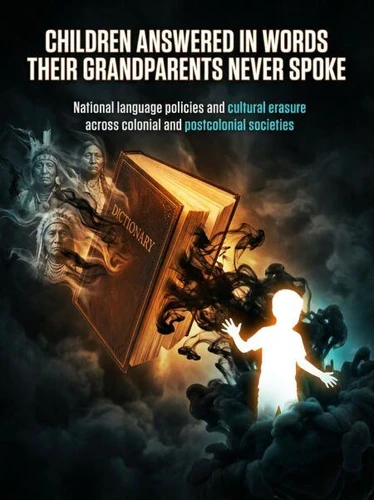
Children Answered in Words Their Grandparents Never Spoke. National language policies and cultural erasure across colonial and postcolonial societies
Par :Formats :
Disponible dans votre compte client Decitre ou Furet du Nord dès validation de votre commande. Le format ePub est :
- Compatible avec une lecture sur My Vivlio (smartphone, tablette, ordinateur)
- Compatible avec une lecture sur liseuses Vivlio
- Pour les liseuses autres que Vivlio, vous devez utiliser le logiciel Adobe Digital Edition. Non compatible avec la lecture sur les liseuses Kindle, Remarkable et Sony
 , qui est-ce ?
Notre partenaire de plateforme de lecture numérique où vous retrouverez l'ensemble de vos ebooks gratuitement
Pour en savoir plus sur nos ebooks, consultez notre aide en ligne ici
C'est si simple ! Lisez votre ebook avec l'app Vivlio sur votre tablette, mobile ou ordinateur :

- Nombre de pages211
- FormatePub
- ISBN978-3-565-47838-5
- EAN9783565478385
- Date de parution05/06/2026
- Protection num.pas de protection
- Taille889 Ko
- Infos supplémentairesepub
- ÉditeurEmphaloz Publishing House
Résumé
Languages rarely disappear naturally. More often, they are pushed aside by schools, courts, military systems, and economic institutions demanding linguistic conformity in exchange for citizenship and survival. Every standardized national language carries a history of voices excluded to create it.
This book examines how empires and modern nation-states used language policy as a political instrument to consolidate authority over minority populations.
Colonial administrations imposed official vocabularies through education systems, legal codes, and bureaucratic procedures designed to weaken regional identities. In many postcolonial states, similar strategies continued under new governments seeking national unity through linguistic standardization. The narrative follows communities whose dialects and oral traditions gradually vanished within a single generation.
Anthropological records, demographic statistics, and field interviews reveal how local languages declined alongside cultural autonomy and collective memory. The disappearance of speech patterns often reflected broader pressures involving migration, economic dependency, and political marginalization. Language emerges here not merely as communication, but as territory itself - a contested space where power determines whose history remains audible and whose fades into silence.
Colonial administrations imposed official vocabularies through education systems, legal codes, and bureaucratic procedures designed to weaken regional identities. In many postcolonial states, similar strategies continued under new governments seeking national unity through linguistic standardization. The narrative follows communities whose dialects and oral traditions gradually vanished within a single generation.
Anthropological records, demographic statistics, and field interviews reveal how local languages declined alongside cultural autonomy and collective memory. The disappearance of speech patterns often reflected broader pressures involving migration, economic dependency, and political marginalization. Language emerges here not merely as communication, but as territory itself - a contested space where power determines whose history remains audible and whose fades into silence.