
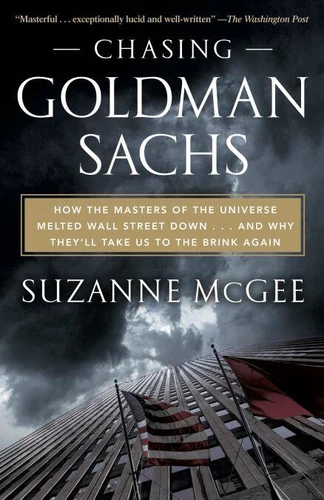
Chasing Goldman Sachs. How the Masters of the Universe Melted Wall Street Down...And Why They'll Take Us to the Brink Again
Par :Formats :
Disponible dans votre compte client Decitre ou Furet du Nord dès validation de votre commande. Le format ePub protégé est :
- Compatible avec une lecture sur My Vivlio (smartphone, tablette, ordinateur)
- Compatible avec une lecture sur liseuses Vivlio
- Pour les liseuses autres que Vivlio, vous devez utiliser le logiciel Adobe Digital Edition. Non compatible avec la lecture sur les liseuses Kindle, Remarkable et Sony
- Non compatible avec un achat hors France métropolitaine
 , qui est-ce ?
Notre partenaire de plateforme de lecture numérique où vous retrouverez l'ensemble de vos ebooks gratuitement
Pour en savoir plus sur nos ebooks, consultez notre aide en ligne ici
C'est si simple ! Lisez votre ebook avec l'app Vivlio sur votre tablette, mobile ou ordinateur :

- Nombre de pages448
- FormatePub
- ISBN978-0-307-46012-7
- EAN9780307460127
- Date de parution15/06/2010
- Protection num.Adobe DRM
- Taille2 Mo
- Infos supplémentairesepub
- ÉditeurCrown Currency
Résumé
You know what happened during the financial crisis . now it is time to understand why the financial system came so close to falling over the edge of the abyss and why it could happen again. Wall Street has been saved, but it hasn't been reformed. What is the problem? Suzanne McGee provides a penetrating look at the forces that transformed Wall Street from its traditional role as a capital-generating and economy-boosting engine into a behemoth operating with only its own short-term interests in mind and with reckless disregard for the broader financial system and those who relied on that system for their well being and prosperity.
Primary among these influences was "Goldman Sachs envy": the self-delusion on the part of Richard Fuld of Lehman Brothers, Stanley O'Neil of Merrill Lynch, and other power brokers (egged on by their shareholders) that taking more risk would enable their companies to make even more money than Goldman Sachs. That hubris-and that narrow-minded focus on maximizing their short-term profits-led them to take extraordinary risks that they couldn't manage and that later severely damaged, and in some cases destroyed, their businesses, wreaking havoc on the nation's economy and millions of 401(k)s in the process.
In a world that boasted more hedge funds than Taco Bell outlets, McGee demonstrates how it became ever harder for Wall Street to fulfill its function as the financial system's version of a power grid, with capital, rather than electricity, flowing through it. But just as a power grid can be strained beyond its capacity, so too can a "financial grid" collapse if its functions are distorted, as happened with Wall Street as it became increasingly self-serving and motivated solely by short-term profits.
Through probing analysis, meticulous research, and dozens of interviews with the bankers, traders, research analysts, and investment managers who have been on the front lines of financial booms and busts, McGee provides a practical understanding of our financial "utility, " and how it touches everyone directly as an investor and indirectly through the power-capital-that makes the economy work. Wall Street is as important to the economy and the overall functioning of our society as our electric and water utilities.
But it doesn't act that way. The financial system has been saved from destruction but as long as the mind-set of "chasing Goldman Sachs" lingers, it will not have been reformed. As banking undergoes its biggest transformation since the 1929 crash and the Great Depression, McGee shows where it stands today and points to where it needs to go next, examining the future of those financial institutions supposedly "too big to fail."
Primary among these influences was "Goldman Sachs envy": the self-delusion on the part of Richard Fuld of Lehman Brothers, Stanley O'Neil of Merrill Lynch, and other power brokers (egged on by their shareholders) that taking more risk would enable their companies to make even more money than Goldman Sachs. That hubris-and that narrow-minded focus on maximizing their short-term profits-led them to take extraordinary risks that they couldn't manage and that later severely damaged, and in some cases destroyed, their businesses, wreaking havoc on the nation's economy and millions of 401(k)s in the process.
In a world that boasted more hedge funds than Taco Bell outlets, McGee demonstrates how it became ever harder for Wall Street to fulfill its function as the financial system's version of a power grid, with capital, rather than electricity, flowing through it. But just as a power grid can be strained beyond its capacity, so too can a "financial grid" collapse if its functions are distorted, as happened with Wall Street as it became increasingly self-serving and motivated solely by short-term profits.
Through probing analysis, meticulous research, and dozens of interviews with the bankers, traders, research analysts, and investment managers who have been on the front lines of financial booms and busts, McGee provides a practical understanding of our financial "utility, " and how it touches everyone directly as an investor and indirectly through the power-capital-that makes the economy work. Wall Street is as important to the economy and the overall functioning of our society as our electric and water utilities.
But it doesn't act that way. The financial system has been saved from destruction but as long as the mind-set of "chasing Goldman Sachs" lingers, it will not have been reformed. As banking undergoes its biggest transformation since the 1929 crash and the Great Depression, McGee shows where it stands today and points to where it needs to go next, examining the future of those financial institutions supposedly "too big to fail."