
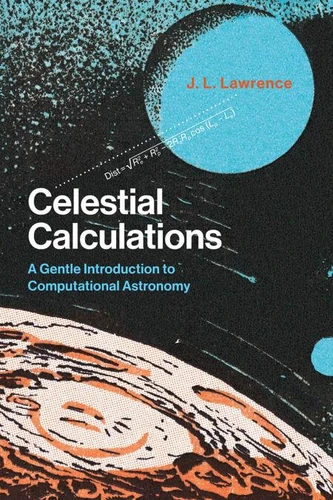
Celestial Calculations. A Gentle Introduction to Computational Astronomy
Par :Formats :
Disponible dans votre compte client Decitre ou Furet du Nord dès validation de votre commande. Le format ePub protégé est :
- Compatible avec une lecture sur My Vivlio (smartphone, tablette, ordinateur)
- Compatible avec une lecture sur liseuses Vivlio
- Pour les liseuses autres que Vivlio, vous devez utiliser le logiciel Adobe Digital Edition. Non compatible avec la lecture sur les liseuses Kindle, Remarkable et Sony
- Non compatible avec un achat hors France métropolitaine
 , qui est-ce ?
Notre partenaire de plateforme de lecture numérique où vous retrouverez l'ensemble de vos ebooks gratuitement
Pour en savoir plus sur nos ebooks, consultez notre aide en ligne ici
C'est si simple ! Lisez votre ebook avec l'app Vivlio sur votre tablette, mobile ou ordinateur :

- Nombre de pages392
- FormatePub
- ISBN978-0-262-35177-5
- EAN9780262351775
- Date de parution14/05/2019
- Protection num.Adobe DRM
- Taille46 Mo
- Infos supplémentairesepub
- ÉditeurThe MIT Press
Résumé
The amateur astronomer's step-by-step guide to predicting and calculating the positions of stars, planets, the sun, the moon, and satellites using a personal computer and high school mathematics!Our knowledge of the universe is expanding rapidly, as space probes launched decades ago begin to send information back to earth. There has never been a better time to learn about how planets, stars, and satellites move through the heavens.
This book is for amateur astronomers who want to move beyond pictures of constellations in star guides and solve the mysteries of a starry night. It is a book for readers who have wondered where Saturn will appear in the night sky, when the sun will rise and set-or how long the space station will be over their location. In Celestial Calculations, J. L. Lawrence shows readers how to find the answers to these and other astronomy questions with only a personal computer and high school math.
Using an easy-to-follow step-by-step approach, Lawrence explains what calculations are required, why they are needed, and how they all fit together. Lawrence begins with basic principles: unit of measure conversions, time conversions, and coordinate systems. He combines these concepts into a computer program that can calculate the location of a star and uses the same methods for predicting the locations of the sun, moon, and planets.
He then shows how to use these methods for locating the many satellites we have sent into orbit. Finally, he describes a variety of resources and tools available to the amateur astronomer, including star charts and astronomical tables. Diagrams illustrate the major concepts, and computer programs that implement the algorithms are included. Photographs of actual celestial objects accompany the text, and interesting astronomical facts are interspersed throughout.
Source code (in Python 3, JAVA, and Visual Basic) and executables for all the programs and examples presented in the book are available for download at https://CelestialCalculations.github.io.
This book is for amateur astronomers who want to move beyond pictures of constellations in star guides and solve the mysteries of a starry night. It is a book for readers who have wondered where Saturn will appear in the night sky, when the sun will rise and set-or how long the space station will be over their location. In Celestial Calculations, J. L. Lawrence shows readers how to find the answers to these and other astronomy questions with only a personal computer and high school math.
Using an easy-to-follow step-by-step approach, Lawrence explains what calculations are required, why they are needed, and how they all fit together. Lawrence begins with basic principles: unit of measure conversions, time conversions, and coordinate systems. He combines these concepts into a computer program that can calculate the location of a star and uses the same methods for predicting the locations of the sun, moon, and planets.
He then shows how to use these methods for locating the many satellites we have sent into orbit. Finally, he describes a variety of resources and tools available to the amateur astronomer, including star charts and astronomical tables. Diagrams illustrate the major concepts, and computer programs that implement the algorithms are included. Photographs of actual celestial objects accompany the text, and interesting astronomical facts are interspersed throughout.
Source code (in Python 3, JAVA, and Visual Basic) and executables for all the programs and examples presented in the book are available for download at https://CelestialCalculations.github.io.