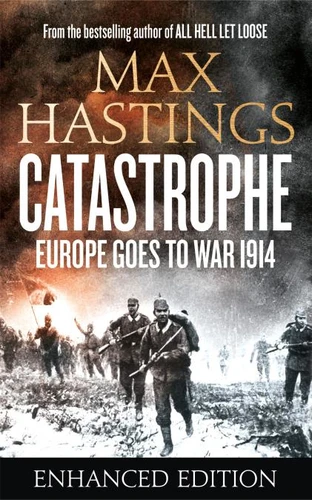
Catastrophe (Enhanced Edition). Europe Goes to War 1914
Par :Formats :
Disponible dans votre compte client Decitre ou Furet du Nord dès validation de votre commande. Le format ePub protégé est :
- Compatible avec une lecture sur My Vivlio (smartphone, tablette, ordinateur)
- Compatible avec une lecture sur liseuses Vivlio
- Pour les liseuses autres que Vivlio, vous devez utiliser le logiciel Adobe Digital Edition. Non compatible avec la lecture sur les liseuses Kindle, Remarkable et Sony
- Non compatible avec un achat hors France métropolitaine
 , qui est-ce ?
Notre partenaire de plateforme de lecture numérique où vous retrouverez l'ensemble de vos ebooks gratuitement
Pour en savoir plus sur nos ebooks, consultez notre aide en ligne ici
C'est si simple ! Lisez votre ebook avec l'app Vivlio sur votre tablette, mobile ou ordinateur :

- Nombre de pages672
- FormatePub
- ISBN978-0-00-754631-2
- EAN9780007546312
- Date de parution12/09/2013
- Protection num.Adobe DRM
- Infos supplémentairesepub
- ÉditeurWilliam Collins
Résumé
Best viewed on a tablet, includes exclusive audio and video.
The special edition of Max Hastings' magisterial chronicle of Europe in 1914. Explore the position of armies in detail. Search the timeline for the ultimate overview. Watch footage of the protagonists, battlefields and wartime cities. Hear an exclusive author interview.
In 1914, Europe plunged into the 20th century's first terrible act of self-immolation- what was then called The Great War.
On the eve of its centenary, Max Hastings seeks to explain both how the conflict came about and what befell millions of men and women during the first months of strife. He finds the evidence overwhelming, that Austria and Germany must accept principal blame for the outbreak. While what followed was a vast tragedy, he argues passionately against the 'poets' view', that the war was not worth winning.
It was vital to the freedom of Europe, he says, that the Kaiser's Germany should be defeated. His narrative of the early battles will astonish those whose images of the war are simply of mud, wire, trenches and steel helmets. Hastings describes how the French Army marched into action amid virgin rural landscapes, in uniforms of red and blue, led by mounted officers, with flags flying and bands playing.
The bloodiest day of the entire Western war fell on 22 August 1914, when the French lost 27, 000 dead. Four days later, at Le Cateau the British fought an extraordinary action against the oncoming Germans, one of the last of its kind in history. In October, at terrible cost they held the allied line against massive German assaults in the first battle of Ypres. The author also describes the brutal struggles in Serbia, East Prussia and Galicia, where by Christmas the Germans, Austrians, Russians and Serbs had inflicted on each other three million casualties. This book offers answers to the huge and fascinating question 'what happened to Europe in 1914?', through Max Hastings's accustomed blend of top-down and bottom-up accounts from a multitude of statesmen and generals, peasants, housewives and private soldiers of seven nations.
His narrative pricks myths and offers some striking and controversial judgements. For a host of readers gripped by the author's last international best-seller All Hell Let Loose, this will seem a worthy successor.
On the eve of its centenary, Max Hastings seeks to explain both how the conflict came about and what befell millions of men and women during the first months of strife. He finds the evidence overwhelming, that Austria and Germany must accept principal blame for the outbreak. While what followed was a vast tragedy, he argues passionately against the 'poets' view', that the war was not worth winning.
It was vital to the freedom of Europe, he says, that the Kaiser's Germany should be defeated. His narrative of the early battles will astonish those whose images of the war are simply of mud, wire, trenches and steel helmets. Hastings describes how the French Army marched into action amid virgin rural landscapes, in uniforms of red and blue, led by mounted officers, with flags flying and bands playing.
The bloodiest day of the entire Western war fell on 22 August 1914, when the French lost 27, 000 dead. Four days later, at Le Cateau the British fought an extraordinary action against the oncoming Germans, one of the last of its kind in history. In October, at terrible cost they held the allied line against massive German assaults in the first battle of Ypres. The author also describes the brutal struggles in Serbia, East Prussia and Galicia, where by Christmas the Germans, Austrians, Russians and Serbs had inflicted on each other three million casualties. This book offers answers to the huge and fascinating question 'what happened to Europe in 1914?', through Max Hastings's accustomed blend of top-down and bottom-up accounts from a multitude of statesmen and generals, peasants, housewives and private soldiers of seven nations.
His narrative pricks myths and offers some striking and controversial judgements. For a host of readers gripped by the author's last international best-seller All Hell Let Loose, this will seem a worthy successor.