
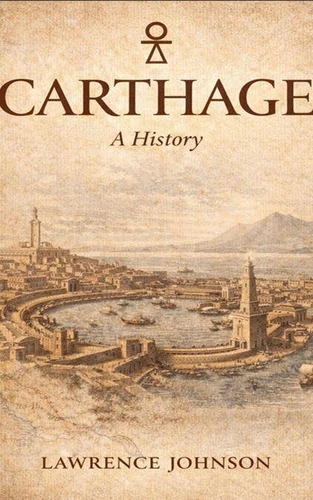
Carthage - A History
Par :Formats :
Disponible dans votre compte client Decitre ou Furet du Nord dès validation de votre commande. Le format ePub est :
- Compatible avec une lecture sur My Vivlio (smartphone, tablette, ordinateur)
- Compatible avec une lecture sur liseuses Vivlio
- Pour les liseuses autres que Vivlio, vous devez utiliser le logiciel Adobe Digital Edition. Non compatible avec la lecture sur les liseuses Kindle, Remarkable et Sony
 , qui est-ce ?
Notre partenaire de plateforme de lecture numérique où vous retrouverez l'ensemble de vos ebooks gratuitement
Pour en savoir plus sur nos ebooks, consultez notre aide en ligne ici
C'est si simple ! Lisez votre ebook avec l'app Vivlio sur votre tablette, mobile ou ordinateur :

- FormatePub
- ISBN8233817694
- EAN9798233817694
- Date de parution01/04/2026
- Protection num.pas de protection
- Infos supplémentairesepub
- ÉditeurLinda Balsamo
Résumé
This book attempts something that the destruction of 146 BCE made permanently difficult: a comprehensive account of Carthaginian civilization from its Phoenician origins to its Roman afterlife, grounded in the available evidence and honest about its limits. The difficulty is not primarily a matter of scholarly effort - a rich and growing body of archaeological, epigraphic, and numismatic research now provides a material record of Punic civilization whose richness continues to expand with each excavation season - but of a specific and irremediable gap at the center of what we can know. Carthage had a literary culture.
It had historians, theologians, agricultural scientists, geographers, and, presumably, poets and philosophers whose work is now entirely lost. The city's libraries burned in 146 BCE, and with them went the internal record of the civilization - the self-understanding, the historical consciousness, the theological elaboration, the literary imagination - that would have allowed us to know Carthage from the inside rather than from the outside looking in.
This book attempts to compensate for the bias of the ancient literary tradition through three strategies. The first is attention to the archaeological record. The second is critical engagement with the ancient sources - reading them for what they can tell us about Carthage even through the distorting lens of hostility. The third is the use of comparative evidence from the Phoenician world more broadly.
None of these strategies produces certainty. At many points in this book, the honest response to a question is 'we do not know, ' and that response is given.
It had historians, theologians, agricultural scientists, geographers, and, presumably, poets and philosophers whose work is now entirely lost. The city's libraries burned in 146 BCE, and with them went the internal record of the civilization - the self-understanding, the historical consciousness, the theological elaboration, the literary imagination - that would have allowed us to know Carthage from the inside rather than from the outside looking in.
This book attempts to compensate for the bias of the ancient literary tradition through three strategies. The first is attention to the archaeological record. The second is critical engagement with the ancient sources - reading them for what they can tell us about Carthage even through the distorting lens of hostility. The third is the use of comparative evidence from the Phoenician world more broadly.
None of these strategies produces certainty. At many points in this book, the honest response to a question is 'we do not know, ' and that response is given.