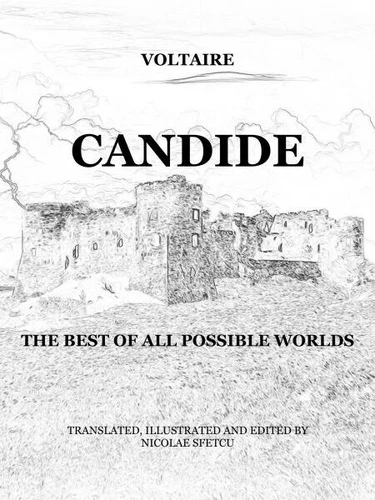
Translated and illustrated by Nicolae Sfetcu. A philosophical tale, a story of a journey that will transform the eponymous hero into a philosopher. An important debate on fatalism and the existence of Evil. For a long time Voltaire has been fiercely opposed to the ideas of the philosopher Leibniz concerning God, the "principle of sufficient reason, " and his idea of ??"pre-established harmony."God is perfect, the world can not be, but God has created the best possible world.
Evil exists punctually, but it is compensated elsewhere by an infinitely great good. Nothing happens without there being a necessary cause. An encouragement to fatalism. Voltaire opposes to this optimism that he considers smug, a lucid vision on the world and its imperfections, a confidence in the man who is able to improve his condition. In Candide, Voltaire openly attacks Leibnizian optimism and makes Pangloss a ridiculous defender of this philosophy.
Criticism of optimism is the main theme of the tale: each of the adventures of the hero tends to prove that it is wrong to believe that our world is the best of all possible worlds.
Translated and illustrated by Nicolae Sfetcu. A philosophical tale, a story of a journey that will transform the eponymous hero into a philosopher. An important debate on fatalism and the existence of Evil. For a long time Voltaire has been fiercely opposed to the ideas of the philosopher Leibniz concerning God, the "principle of sufficient reason, " and his idea of ??"pre-established harmony."God is perfect, the world can not be, but God has created the best possible world.
Evil exists punctually, but it is compensated elsewhere by an infinitely great good. Nothing happens without there being a necessary cause. An encouragement to fatalism. Voltaire opposes to this optimism that he considers smug, a lucid vision on the world and its imperfections, a confidence in the man who is able to improve his condition. In Candide, Voltaire openly attacks Leibnizian optimism and makes Pangloss a ridiculous defender of this philosophy.
Criticism of optimism is the main theme of the tale: each of the adventures of the hero tends to prove that it is wrong to believe that our world is the best of all possible worlds.


 , qui est-ce ?