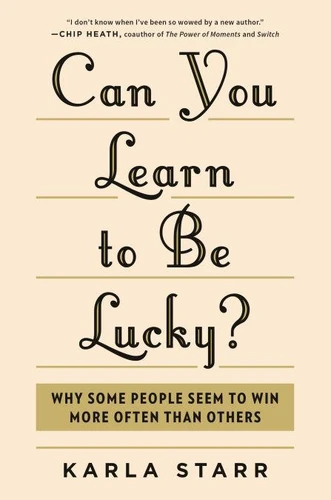
Can You Learn to Be Lucky?. Why Some People Seem to Win More Often Than Others
Par :Formats :
Disponible dans votre compte client Decitre ou Furet du Nord dès validation de votre commande. Le format ePub protégé est :
- Compatible avec une lecture sur My Vivlio (smartphone, tablette, ordinateur)
- Compatible avec une lecture sur liseuses Vivlio
- Pour les liseuses autres que Vivlio, vous devez utiliser le logiciel Adobe Digital Edition. Non compatible avec la lecture sur les liseuses Kindle, Remarkable et Sony
- Non compatible avec un achat hors France métropolitaine
 , qui est-ce ?
Notre partenaire de plateforme de lecture numérique où vous retrouverez l'ensemble de vos ebooks gratuitement
Pour en savoir plus sur nos ebooks, consultez notre aide en ligne ici
C'est si simple ! Lisez votre ebook avec l'app Vivlio sur votre tablette, mobile ou ordinateur :

- Nombre de pages288
- FormatePub
- ISBN978-0-698-13981-7
- EAN9780698139817
- Date de parution14/08/2018
- Protection num.Adobe DRM
- Taille1 Mo
- Infos supplémentairesepub
- ÉditeurPortfolio
Résumé
"I don't know when I've been so wowed by a new author" -Chip Health, co-author of The Power of Moments and SwitchA talented journalist reveals the hidden patterns behind what we call "luck" -- and shows us how we can all improve outcomes despite life's inevitable randomness."Do you believe in luck?" is a polarizing question, one you might ask on a first date. Some of us believe that we make our own luck.
Others see inequality everywhere and think that everyone's fate is at the whim of the cosmos. Karla Starr has a third answer: unlucky, "random" outcomes have predictable effects on our behavior that often make us act in self-defeating ways without even realizing it. In this groundbreaking book, Starr traces wealth, health, and happiness back to subconscious neurological processes, blind cultural assumptions, and tiny details you're in the habit of overlooking.
Each chapter reveals how we can cultivate personal strengths to overcome life's unlucky patterns. For instance:. Everyone has free access to that magic productivity app-motivation. The problem? It isn't evenly distributed. What lucky accidents of history explain patterns behind why certain groups of people are more motivated in some situations than others? . If you look like an underperforming employee, your resume can't override the gut-level assumptions that a potential boss will make from your LinkedIn photo.
How can we make sure that someone's first impression is favorable?. Just as people use irrelevant traits to make assumptions about your intelligence, kindness, and trustworthiness, we also make inaccurate snap judgments. How do these judgments affect our interactions, and what should we assume about others to maximize our odds of having lucky encounters? We don't always realize when the world's invisible biases work to our advantage or recognize how much of a role we play in our own lack of luck.
By ending the guessing game about how luck works, Starr allows you to improve your fortunes while expending minimal effort.
Others see inequality everywhere and think that everyone's fate is at the whim of the cosmos. Karla Starr has a third answer: unlucky, "random" outcomes have predictable effects on our behavior that often make us act in self-defeating ways without even realizing it. In this groundbreaking book, Starr traces wealth, health, and happiness back to subconscious neurological processes, blind cultural assumptions, and tiny details you're in the habit of overlooking.
Each chapter reveals how we can cultivate personal strengths to overcome life's unlucky patterns. For instance:. Everyone has free access to that magic productivity app-motivation. The problem? It isn't evenly distributed. What lucky accidents of history explain patterns behind why certain groups of people are more motivated in some situations than others? . If you look like an underperforming employee, your resume can't override the gut-level assumptions that a potential boss will make from your LinkedIn photo.
How can we make sure that someone's first impression is favorable?. Just as people use irrelevant traits to make assumptions about your intelligence, kindness, and trustworthiness, we also make inaccurate snap judgments. How do these judgments affect our interactions, and what should we assume about others to maximize our odds of having lucky encounters? We don't always realize when the world's invisible biases work to our advantage or recognize how much of a role we play in our own lack of luck.
By ending the guessing game about how luck works, Starr allows you to improve your fortunes while expending minimal effort.