
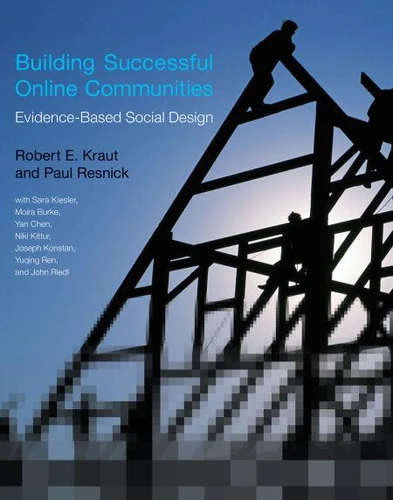
Building Successful Online Communities. Evidence-Based Social Design
Par : , , , ,Formats :
Disponible dans votre compte client Decitre ou Furet du Nord dès validation de votre commande. Le format ePub protégé est :
- Compatible avec une lecture sur My Vivlio (smartphone, tablette, ordinateur)
- Compatible avec une lecture sur liseuses Vivlio
- Pour les liseuses autres que Vivlio, vous devez utiliser le logiciel Adobe Digital Edition. Non compatible avec la lecture sur les liseuses Kindle, Remarkable et Sony
- Non compatible avec un achat hors France métropolitaine
 , qui est-ce ?
Notre partenaire de plateforme de lecture numérique où vous retrouverez l'ensemble de vos ebooks gratuitement
Pour en savoir plus sur nos ebooks, consultez notre aide en ligne ici
C'est si simple ! Lisez votre ebook avec l'app Vivlio sur votre tablette, mobile ou ordinateur :

- Nombre de pages328
- FormatePub
- ISBN978-0-262-29739-4
- EAN9780262297394
- Date de parution23/03/2012
- Protection num.Adobe DRM
- Taille8 Mo
- Infos supplémentairesepub
- ÉditeurThe MIT Press
Résumé
How insights from the social sciences, including social psychology and economics, can improve the design of online communities. Online communities are among the most popular destinations on the Internet, but not all online communities are equally successful. For every flourishing Facebook, there is a moribund Friendster-not to mention the scores of smaller social networking sites that never attracted enough members to be viable.
This book offers lessons from theory and empirical research in the social sciences that can help improve the design of online communities. The authors draw on the literature in psychology, economics, and other social sciences, as well as their own research, translating general findings into useful design claims. They explain, for example, how to encourage information contributions based on the theory of public goods, and how to build members' commitment based on theories of interpersonal bond formation.
For each design claim, they offer supporting evidence from theory, experiments, or observational studies.
This book offers lessons from theory and empirical research in the social sciences that can help improve the design of online communities. The authors draw on the literature in psychology, economics, and other social sciences, as well as their own research, translating general findings into useful design claims. They explain, for example, how to encourage information contributions based on the theory of public goods, and how to build members' commitment based on theories of interpersonal bond formation.
For each design claim, they offer supporting evidence from theory, experiments, or observational studies.