
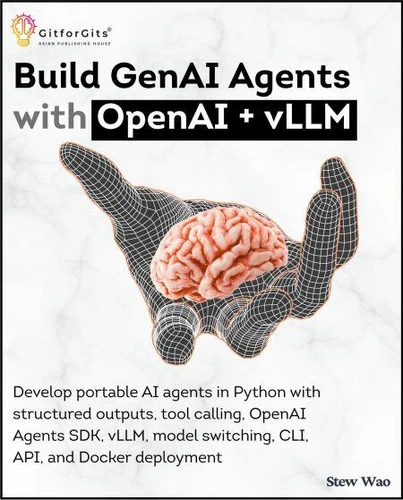
Build GenAI Agents with OpenAI + vLLM
Par :Formats :
Disponible dans votre compte client Decitre ou Furet du Nord dès validation de votre commande. Le format ePub protégé est :
- Compatible avec une lecture sur My Vivlio (smartphone, tablette, ordinateur)
- Compatible avec une lecture sur liseuses Vivlio
- Pour les liseuses autres que Vivlio, vous devez utiliser le logiciel Adobe Digital Edition. Non compatible avec la lecture sur les liseuses Kindle, Remarkable et Sony
- Non compatible avec un achat hors France métropolitaine
 , qui est-ce ?
Notre partenaire de plateforme de lecture numérique où vous retrouverez l'ensemble de vos ebooks gratuitement
Pour en savoir plus sur nos ebooks, consultez notre aide en ligne ici
C'est si simple ! Lisez votre ebook avec l'app Vivlio sur votre tablette, mobile ou ordinateur :

- FormatePub
- ISBN8233653759
- EAN9798233653759
- Date de parution28/02/2026
- Protection num.Adobe DRM
- Infos supplémentairesepub
- ÉditeurLinda Balsamo
Résumé
AI agents are getting easier to build, but the surrounding ecosystem of models, SDKs, and frameworks is changing quickly. A lot of agent apps get tricky to maintain since they depend too much on a certain provider, library, or deployment setup. This book looks at a practical alternative, which is to make AI agents whose main logic doesn't change while models, SDKs, and runtimes can be changed around it.
It's not about using complicated frameworks. Rather, this book shows you simple architectural patterns that let you set up an agent application so that tools, schemas, prompts, and business logic can stay separate from the runtime layer. For starters, it'll be a simple loop with agents, and we'll gradually build on that with tools that make things deterministic, outputs in a structured JSON format, and schema validation.
It'll teach skills, like switching between models through configuration, running the same agent with hosted models or local inference using vLLM, and isolating SDK-specific integrations behind small adapter layers. Later, we will focus on packaging and deployment, in which we will convert the agent into a command-line tool, expose it through a minimal HTTP API, and package the application using Docker.
Ultimately, the book puts the project together as a reusable starter template that can be used as a basis for future agent-based applications. Basically, this book is perfect for Python developers, software engineers, and AI practitioners who want a step-by-step process for designing agents that can adapt as the surrounding ecosystem changes. Key LearningsBuild GenAI agents using simple agent loop that accepts prompts, calls tools, and returns structured AI responses.
Use structured JSON outputs and Pydantic schemas to make AI agent responses reliable and safe for automation. Design AI tools as deterministic Python functions so agents can call calculators, summarizers, and utilities predictably. Create portable AI agents by separating business logic from LLM and model APIs. Implement a model gateway pattern to switch between OpenAI models, local LLMs, or other providers via configuration.
Run the same agent with OpenAI models or local LLM inference using vLLM. Prevent SDK lock-in by isolating AI SDK integrations behind runtime adapters. Use LLM regression prompts and schema validation for better stability of AI Agents during switching the models. Package AI agent as CLI tool and HTTP API for real applications and integrations. Deploy AI agents with Docker containers and environment variable.
It's not about using complicated frameworks. Rather, this book shows you simple architectural patterns that let you set up an agent application so that tools, schemas, prompts, and business logic can stay separate from the runtime layer. For starters, it'll be a simple loop with agents, and we'll gradually build on that with tools that make things deterministic, outputs in a structured JSON format, and schema validation.
It'll teach skills, like switching between models through configuration, running the same agent with hosted models or local inference using vLLM, and isolating SDK-specific integrations behind small adapter layers. Later, we will focus on packaging and deployment, in which we will convert the agent into a command-line tool, expose it through a minimal HTTP API, and package the application using Docker.
Ultimately, the book puts the project together as a reusable starter template that can be used as a basis for future agent-based applications. Basically, this book is perfect for Python developers, software engineers, and AI practitioners who want a step-by-step process for designing agents that can adapt as the surrounding ecosystem changes. Key LearningsBuild GenAI agents using simple agent loop that accepts prompts, calls tools, and returns structured AI responses.
Use structured JSON outputs and Pydantic schemas to make AI agent responses reliable and safe for automation. Design AI tools as deterministic Python functions so agents can call calculators, summarizers, and utilities predictably. Create portable AI agents by separating business logic from LLM and model APIs. Implement a model gateway pattern to switch between OpenAI models, local LLMs, or other providers via configuration.
Run the same agent with OpenAI models or local LLM inference using vLLM. Prevent SDK lock-in by isolating AI SDK integrations behind runtime adapters. Use LLM regression prompts and schema validation for better stability of AI Agents during switching the models. Package AI agent as CLI tool and HTTP API for real applications and integrations. Deploy AI agents with Docker containers and environment variable.