
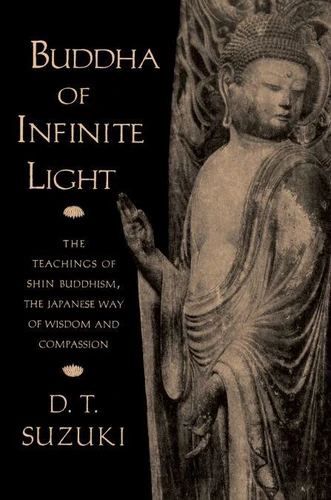
Buddha of Infinite Light. The Teachings of Shin Buddhism, the Japanese Way of Wisdom and Compassion
Par :Formats :
Disponible dans votre compte client Decitre ou Furet du Nord dès validation de votre commande. Le format ePub protégé est :
- Compatible avec une lecture sur My Vivlio (smartphone, tablette, ordinateur)
- Compatible avec une lecture sur liseuses Vivlio
- Pour les liseuses autres que Vivlio, vous devez utiliser le logiciel Adobe Digital Edition. Non compatible avec la lecture sur les liseuses Kindle, Remarkable et Sony
- Non compatible avec un achat hors France métropolitaine
 , qui est-ce ?
Notre partenaire de plateforme de lecture numérique où vous retrouverez l'ensemble de vos ebooks gratuitement
Pour en savoir plus sur nos ebooks, consultez notre aide en ligne ici
C'est si simple ! Lisez votre ebook avec l'app Vivlio sur votre tablette, mobile ou ordinateur :

- Nombre de pages96
- FormatePub
- ISBN0-8348-2864-2
- EAN9780834828643
- Date de parution12/02/2002
- Protection num.Adobe DRM
- Taille208 Ko
- Infos supplémentairesepub
- ÉditeurShambhala
Résumé
Shin is the uniquely Japanese flowering of the type of Buddhism known as "Pure Land." It originated in the thirteenth century with the charismatic and prophetic figure Shinran (1172-1263), whose interpretation of the traditional Pure Land teachings was extremely influential in his own lifetime and remain so today. In a period when Japanese Buddhism was dominated by an elitist monastic establishment, Shinran's Shin teaching became a way of liberation for all people, regardless of age, class, or gender.
Although Shin is one of Japan's greatest religious contributions-and is still the most widely practiced form of Buddhism in Japan-it remains little known in the West. In this book, based on several lectures he gave in the 1950s, D. T. Suzuki illuminates the deep meaning of Shin and its rich archetypal imagery, providing a scholarly and affectionate introduction to this sometimes misunderstood tradition of Buddhist practice.
Although Shin is one of Japan's greatest religious contributions-and is still the most widely practiced form of Buddhism in Japan-it remains little known in the West. In this book, based on several lectures he gave in the 1950s, D. T. Suzuki illuminates the deep meaning of Shin and its rich archetypal imagery, providing a scholarly and affectionate introduction to this sometimes misunderstood tradition of Buddhist practice.