
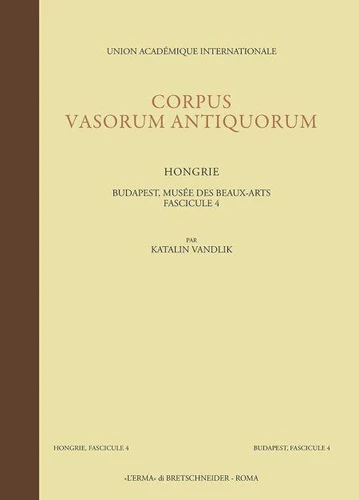
Budapest, Musée des Beaux-Arts, Fascicule 4. Corpus Vasorum Antiquorum. Hongrie 4
Par :Formats :
Disponible dans votre compte client Decitre ou Furet du Nord dès validation de votre commande. Le format PDF est :
- Compatible avec une lecture sur My Vivlio (smartphone, tablette, ordinateur)
- Compatible avec une lecture sur liseuses Vivlio
- Pour les liseuses autres que Vivlio, vous devez utiliser le logiciel Adobe Digital Edition. Non compatible avec la lecture sur les liseuses Kindle, Remarkable et Sony
 , qui est-ce ?
Notre partenaire de plateforme de lecture numérique où vous retrouverez l'ensemble de vos ebooks gratuitement
Pour en savoir plus sur nos ebooks, consultez notre aide en ligne ici
C'est si simple ! Lisez votre ebook avec l'app Vivlio sur votre tablette, mobile ou ordinateur :

- Nombre de pages162
- FormatPDF
- ISBN978-88-913-2815-1
- EAN9788891328151
- Date de parution01/01/2023
- Protection num.Digital Watermarking
- Taille20 Mo
- Infos supplémentairespdf
- ÉditeurL'Erma
Résumé
The volume of Corpus Vasorum Antiquorum Hongrie 4 is also the fourth volume of the Corpus Vasorum Antiquorum series of the Museum of Fine Arts in Budapest. First of all, it contains the Apulian red-figure vases and the black-glazed pottery preserved in the Collection of Classical Antiquities in the museum. It also comprises red-figure and polichrome vases from Campanian, Lucanian, Paestean, Sicilian, and other South-Italian workshops, as well as other painted vases (Gnathia), which were aquired by the museum after the publication of the volumes CVA Hongrie 1 and CVA Hongrie 2.
The products of these workshops were published in these volumes in 1981 and 2007. The black-glazed pottery in volume 4 includes black-glazed vases from Attic and Boeotian workshops, as well as from Apulian, Campanian, and other South-Italian workshops, and also products from other non-defined Italian workshops, which are represented in relatively small numbers in the Collection of Classical Antiquities.
In the CVA Hongrie 4, the painted pottery is dated to the 4th century BC, while the black-glazed material is dated to between the 5th and 3rd centuries. The objects originate mostly from former private collections, for example that of Emil Prinz zu Sayn-Wittgenstein Berleburg, that of the painter Antal Haán who lived in Italy, the famous art collector, Marcell Nemes, or that of Béla Gerster, who was the engineer of the Corinthian Canal.
The products of these workshops were published in these volumes in 1981 and 2007. The black-glazed pottery in volume 4 includes black-glazed vases from Attic and Boeotian workshops, as well as from Apulian, Campanian, and other South-Italian workshops, and also products from other non-defined Italian workshops, which are represented in relatively small numbers in the Collection of Classical Antiquities.
In the CVA Hongrie 4, the painted pottery is dated to the 4th century BC, while the black-glazed material is dated to between the 5th and 3rd centuries. The objects originate mostly from former private collections, for example that of Emil Prinz zu Sayn-Wittgenstein Berleburg, that of the painter Antal Haán who lived in Italy, the famous art collector, Marcell Nemes, or that of Béla Gerster, who was the engineer of the Corinthian Canal.