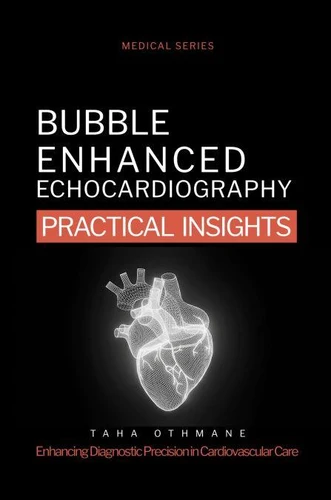
Bubble Enhanced Echocardiography: Practical Insights. Medical Series
Par :Formats :
Disponible dans votre compte client Decitre ou Furet du Nord dès validation de votre commande. Le format ePub est :
- Compatible avec une lecture sur My Vivlio (smartphone, tablette, ordinateur)
- Compatible avec une lecture sur liseuses Vivlio
- Pour les liseuses autres que Vivlio, vous devez utiliser le logiciel Adobe Digital Edition. Non compatible avec la lecture sur les liseuses Kindle, Remarkable et Sony
 , qui est-ce ?
Notre partenaire de plateforme de lecture numérique où vous retrouverez l'ensemble de vos ebooks gratuitement
Pour en savoir plus sur nos ebooks, consultez notre aide en ligne ici
C'est si simple ! Lisez votre ebook avec l'app Vivlio sur votre tablette, mobile ou ordinateur :

- FormatePub
- ISBN8231864850
- EAN9798231864850
- Date de parution25/06/2025
- Protection num.pas de protection
- Infos supplémentairesepub
- ÉditeurWalzone Press
Résumé
Bubble Enhanced Echocardiography: Practical Insights is a practical, clinically focused guide to the performance, interpretation, and clinical application of contrast-enhanced bubble studies in cardiovascular medicine. Designed for everyday clinical practice, this book provides a structured framework for evaluating intracardiac and intrapulmonary shunts using transthoracic and transesophageal echocardiography.
From the fundamentals of ultrasound physics and shunting physiology to advanced interpretation and case-based decision-making, this volume translates a technically sensitive procedure into clear, actionable clinical practice. Emphasis is placed on accurate image acquisition, optimization of the Valsalva maneuver, timing of contrast appearance, and differentiation between cardiac and pulmonary shunts.
Key topics include: Bubble echocardiography techniques using transthoracic (TTE) and transesophageal echocardiography (TEE) Patent foramen ovale (PFO) detection and assessment, including cryptogenic stroke evaluation Intracardiac versus intrapulmonary shunt interpretation and grading strategies Agitated saline preparation, injection techniques, and procedural optimization Structured interpretation and reporting, including standardized terminology and clinical recommendations Common pitfalls, artifacts, and troubleshooting strategies to improve diagnostic accuracy Clinical applications in stroke, liver disease, pulmonary vascular disorders, and interventional cardiology The book combines practical procedural guidance with evidence-based clinical reasoning, helping clinicians understand not only how to perform a bubble study, but also how to interpret findings within the broader context of patient management.
Real-world case studies and diagnostic scenarios reinforce key concepts and highlight common interpretative challenges. Special focus is given to: PFO-related stroke work-up and risk stratification Hepatopulmonary syndrome and pulmonary arteriovenous malformations Clinical implications of positive bubble studies and post-procedural follow-up after PFO closure Emerging technologies, including artificial intelligence, 3D echocardiography, and portable imaging systems, are also explored, providing insight into the evolving future of shunt assessment and contrast-enhanced imaging.
Who This Book Is For Cardiologists and echocardiography specialists Cardiology trainees and fellows Stroke physicians and neurologists Sonographers and cardiac physiologists Healthcare professionals involved in structural heart disease evaluation Key Features Step-by-step practical protocols for TTE and TEE bubble studies Structured interpretation and reporting frameworks Clinical integration with stroke and structural heart disease management Troubleshooting guidance and artifact recognition Real-world case studies and diagnostic algorithms Part of the Clinical Practical Insights series, this book serves as a concise yet comprehensive reference for clinicians seeking to perform and interpret bubble enhanced echocardiography with greater precision, confidence, and clinical relevance.
From the fundamentals of ultrasound physics and shunting physiology to advanced interpretation and case-based decision-making, this volume translates a technically sensitive procedure into clear, actionable clinical practice. Emphasis is placed on accurate image acquisition, optimization of the Valsalva maneuver, timing of contrast appearance, and differentiation between cardiac and pulmonary shunts.
Key topics include: Bubble echocardiography techniques using transthoracic (TTE) and transesophageal echocardiography (TEE) Patent foramen ovale (PFO) detection and assessment, including cryptogenic stroke evaluation Intracardiac versus intrapulmonary shunt interpretation and grading strategies Agitated saline preparation, injection techniques, and procedural optimization Structured interpretation and reporting, including standardized terminology and clinical recommendations Common pitfalls, artifacts, and troubleshooting strategies to improve diagnostic accuracy Clinical applications in stroke, liver disease, pulmonary vascular disorders, and interventional cardiology The book combines practical procedural guidance with evidence-based clinical reasoning, helping clinicians understand not only how to perform a bubble study, but also how to interpret findings within the broader context of patient management.
Real-world case studies and diagnostic scenarios reinforce key concepts and highlight common interpretative challenges. Special focus is given to: PFO-related stroke work-up and risk stratification Hepatopulmonary syndrome and pulmonary arteriovenous malformations Clinical implications of positive bubble studies and post-procedural follow-up after PFO closure Emerging technologies, including artificial intelligence, 3D echocardiography, and portable imaging systems, are also explored, providing insight into the evolving future of shunt assessment and contrast-enhanced imaging.
Who This Book Is For Cardiologists and echocardiography specialists Cardiology trainees and fellows Stroke physicians and neurologists Sonographers and cardiac physiologists Healthcare professionals involved in structural heart disease evaluation Key Features Step-by-step practical protocols for TTE and TEE bubble studies Structured interpretation and reporting frameworks Clinical integration with stroke and structural heart disease management Troubleshooting guidance and artifact recognition Real-world case studies and diagnostic algorithms Part of the Clinical Practical Insights series, this book serves as a concise yet comprehensive reference for clinicians seeking to perform and interpret bubble enhanced echocardiography with greater precision, confidence, and clinical relevance.