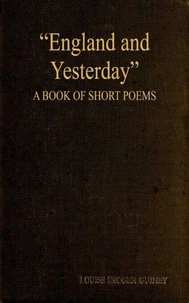
Louise Imogen Guiney (January 7, 1861 November 2, 1920) was an American poet, essayist and editor, born in Roxbury, Massachusetts.
Brownies and Bogles
Par : ,Formats :
Disponible dans votre compte client Decitre ou Furet du Nord dès validation de votre commande. Le format ePub est :
- Compatible avec une lecture sur My Vivlio (smartphone, tablette, ordinateur)
- Compatible avec une lecture sur liseuses Vivlio
- Pour les liseuses autres que Vivlio, vous devez utiliser le logiciel Adobe Digital Edition. Non compatible avec la lecture sur les liseuses Kindle, Remarkable et Sony
 , qui est-ce ?
Notre partenaire de plateforme de lecture numérique où vous retrouverez l'ensemble de vos ebooks gratuitement
Pour en savoir plus sur nos ebooks, consultez notre aide en ligne ici
C'est si simple ! Lisez votre ebook avec l'app Vivlio sur votre tablette, mobile ou ordinateur :

- Nombre de pages150
- FormatePub
- ISBN978-605-9285-72-8
- EAN9786059285728
- Date de parution24/11/2024
- Protection num.Digital Watermarking
- Taille7 Mo
- Infos supplémentairesepub
- ÉditeurE-Kitap Projesi & Cheapest Boo
Résumé
A FAIRY is a humorous person sadly out of fashion at pre-sent, who has had, nevertheless, in the actors' phrase, a long and prosperous run on this planet. When we speak of fairies nowadays, we think only of small sprites who live in a kingdom of their own, with manners, laws, and privileges very different from ours. But there was a time when "fairy" suggested also the knights and ladies of romance, about whom fine spirited tales were told when the world was younger.
Spenser's Faery Queen, for instance, deals with dream-people, beautiful and brave, as do the old stories of Arthur and Roland; people who either never lived, or who, having lived, were glorified and magnified by tradition out of all kinship with common men. Our fairies are fairies in the modern sense. We will make it a rule, from the beginning, that they must be small, and we will put out any who are above the regulation height.
Such as the charming famous MELUSINA, who wails upon her tower at the death of a LUSIGNAN, we may as well skip; for she is a tall young lady, with a serpent's tail, to boot, and thus, alas! half-monster; for if we should accept any like her in our plan, there is no reason why we should not get confused among MERMAIDS and DRYADS, and perhaps end by scoring down great JUNO herself as a fairy! Many a DWARF and GOBLIN, whom we shall meet ANON, is as big as a child."ELF" and "GOBLIN, " too, are interesting to trace.
There was a great Italian feud, in the twelfth century, between the German Emperor and the Pope, whose separate partisans were known as the GUELFs and the GHIBELLINEs. As time went on, and the memory of that long strife was still fresh, a descendant of the Guelfs would put upon anybody he disliked the odious name of Ghibelline; and the latter, generation after generation, would return the compliment ardently, in his own fashion.
Both terms, finally, came to be mere catch-words for abuse and reproach. And the fairies, falling into disfavor with some bold mortals, were angrily nicknamed "elf" and "goblin"; in which shape you will recognize the last threadbare reminder of the once bitter and historic faction of Guelf and Ghibelline.
Spenser's Faery Queen, for instance, deals with dream-people, beautiful and brave, as do the old stories of Arthur and Roland; people who either never lived, or who, having lived, were glorified and magnified by tradition out of all kinship with common men. Our fairies are fairies in the modern sense. We will make it a rule, from the beginning, that they must be small, and we will put out any who are above the regulation height.
Such as the charming famous MELUSINA, who wails upon her tower at the death of a LUSIGNAN, we may as well skip; for she is a tall young lady, with a serpent's tail, to boot, and thus, alas! half-monster; for if we should accept any like her in our plan, there is no reason why we should not get confused among MERMAIDS and DRYADS, and perhaps end by scoring down great JUNO herself as a fairy! Many a DWARF and GOBLIN, whom we shall meet ANON, is as big as a child."ELF" and "GOBLIN, " too, are interesting to trace.
There was a great Italian feud, in the twelfth century, between the German Emperor and the Pope, whose separate partisans were known as the GUELFs and the GHIBELLINEs. As time went on, and the memory of that long strife was still fresh, a descendant of the Guelfs would put upon anybody he disliked the odious name of Ghibelline; and the latter, generation after generation, would return the compliment ardently, in his own fashion.
Both terms, finally, came to be mere catch-words for abuse and reproach. And the fairies, falling into disfavor with some bold mortals, were angrily nicknamed "elf" and "goblin"; in which shape you will recognize the last threadbare reminder of the once bitter and historic faction of Guelf and Ghibelline.