
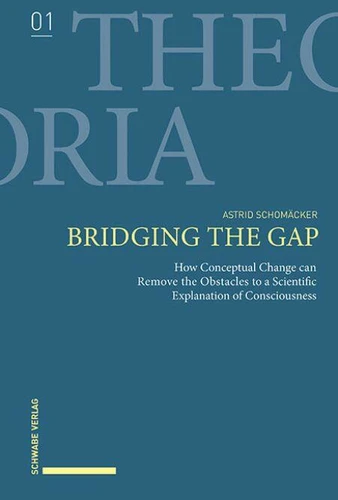
Bridging the Gap. How Conceptual Change can Remove the Obstacles to a Scientific Explanation of Consciousness.
Par :Formats :
Disponible dans votre compte client Decitre ou Furet du Nord dès validation de votre commande. Le format PDF est :
- Compatible avec une lecture sur My Vivlio (smartphone, tablette, ordinateur)
- Compatible avec une lecture sur liseuses Vivlio
- Pour les liseuses autres que Vivlio, vous devez utiliser le logiciel Adobe Digital Edition. Non compatible avec la lecture sur les liseuses Kindle, Remarkable et Sony
 , qui est-ce ?
Notre partenaire de plateforme de lecture numérique où vous retrouverez l'ensemble de vos ebooks gratuitement
Pour en savoir plus sur nos ebooks, consultez notre aide en ligne ici
C'est si simple ! Lisez votre ebook avec l'app Vivlio sur votre tablette, mobile ou ordinateur :

- Nombre de pages286
- FormatPDF
- ISBN978-3-7574-0041-5
- EAN9783757400415
- Date de parution13/05/2020
- Protection num.Digital Watermarking
- Taille2 Mo
- Infos supplémentairespdf
- ÉditeurSchwabe Verlag (Berlin)
Résumé
Can consciousness be scientifically explained? While scientific knowledge of the brain is still lacking in many ways, philosophers like Joseph Levine and David Chalmers have already argued that such an explanation is impossible. The book addresses this widely discussed argument from a new angle: It starts from the fact that the arguments for the so called "explanatory gap" rely crucially on our current concept of consciousness.
The present work therefore looks at the possibility of conceptual change as a way to remove the obstacles to a scientific explanation of consciousness. It presents a possible development of our concept of consciousness which would allow for an explanation and shows that the arguments for the gap can therefore be refuted.
The present work therefore looks at the possibility of conceptual change as a way to remove the obstacles to a scientific explanation of consciousness. It presents a possible development of our concept of consciousness which would allow for an explanation and shows that the arguments for the gap can therefore be refuted.