
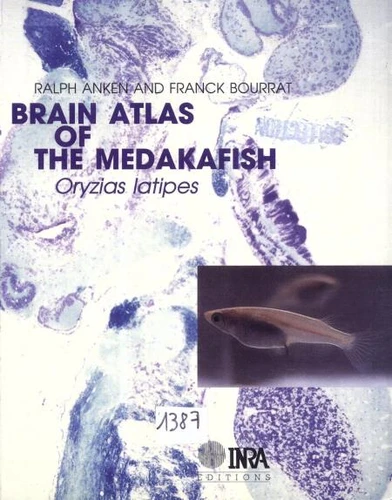
Brain atlas of the mekadafish
Par : ,Formats :
Disponible dans votre compte client Decitre ou Furet du Nord dès validation de votre commande. Le format Multi-format est :
- Pour les liseuses autres que Vivlio, vous devez utiliser le logiciel Adobe Digital Edition. Non compatible avec la lecture sur les liseuses Kindle, Remarkable et Sony
 , qui est-ce ?
Notre partenaire de plateforme de lecture numérique où vous retrouverez l'ensemble de vos ebooks gratuitement
Pour en savoir plus sur nos ebooks, consultez notre aide en ligne ici
C'est si simple ! Lisez votre ebook avec l'app Vivlio sur votre tablette, mobile ou ordinateur :

- FormatMulti-format
- ISBN978-2-7592-0526-4
- EAN9782759205264
- Date de parution01/06/2008
- Protection num.pas de protection
- Infos supplémentairesMulti-Format
- ÉditeurQuae éditions
Résumé
The medaka (Oryzias latipes), a small freshwater teleost from Japon and South-East Asia, is an increasingly popular vertebrate model in biology. However, the anatomical data available on this species are scarce, or difficult to access, a relative lack that is ail the more regrettable tor the central nervous System (CNS), This atlas is composed of 55 serial transverse sections (microphotographs and mirror-image drawings with named structures - using up-to-date nomenclature) of adult medaka CNS, along with 7 horizontal and 7 sagittal sections.
Small aquarium teleosts (medaka and zebrafish) are mostly used today for developmental genetic analysis. In this context, this atlas is primarily intended for researchers with an interest in identification of CNS structures where newly cloned genes are expressed. Developmental and/or evolutionary neurobiologists should be especially interested by comparisons of expression patterns with relatively close species (the zebrafish), and distant ones (the rat or the mouse)
Small aquarium teleosts (medaka and zebrafish) are mostly used today for developmental genetic analysis. In this context, this atlas is primarily intended for researchers with an interest in identification of CNS structures where newly cloned genes are expressed. Developmental and/or evolutionary neurobiologists should be especially interested by comparisons of expression patterns with relatively close species (the zebrafish), and distant ones (the rat or the mouse)