
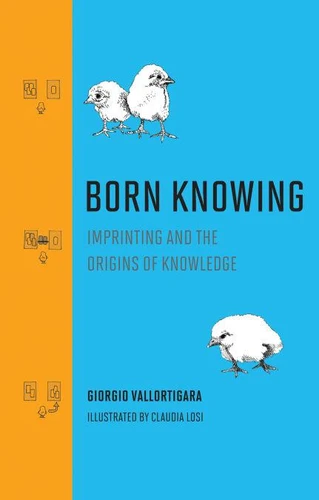
Born Knowing. Imprinting and the Origins of Knowledge
Par : ,Formats :
Disponible dans votre compte client Decitre ou Furet du Nord dès validation de votre commande. Le format ePub protégé est :
- Compatible avec une lecture sur My Vivlio (smartphone, tablette, ordinateur)
- Compatible avec une lecture sur liseuses Vivlio
- Pour les liseuses autres que Vivlio, vous devez utiliser le logiciel Adobe Digital Edition. Non compatible avec la lecture sur les liseuses Kindle, Remarkable et Sony
- Non compatible avec un achat hors France métropolitaine
 , qui est-ce ?
Notre partenaire de plateforme de lecture numérique où vous retrouverez l'ensemble de vos ebooks gratuitement
Pour en savoir plus sur nos ebooks, consultez notre aide en ligne ici
C'est si simple ! Lisez votre ebook avec l'app Vivlio sur votre tablette, mobile ou ordinateur :

- Nombre de pages192
- FormatePub
- ISBN978-0-262-36586-4
- EAN9780262365864
- Date de parution28/09/2021
- Protection num.Adobe DRM
- Taille27 Mo
- Infos supplémentairesepub
- ÉditeurThe MIT Press
Résumé
An expert on the brain argues that the mind is not a blank slate and that much early behavior is biologically predisposed rather than learned. Why do newborns show a preference for a face (or something that resembles a face) over a nonface-like object? Why do baby chicks prefer a moving object to an inanimate one? Neither baby human nor baby chick has had time to learn to like faces or movement. In Born Knowing, neuroscientist Giorgio Vallortigara argues that the mind is not a blank slate.
Early behavior is biologically predisposed rather than learned, and this instinctive or innate behavior, Vallortigara says, is key to understanding the origins of knowledge. Drawing on research carried out in his own laboratory over several decades, Vallortigara explores what the imprinting process in young chicks, paralleled by the cognitive feats of human newborns, reveals about minds at the onset of life.
He explains that a preference for faces or representations of something face-like and animate objects--predispositions he calls "life detectors"--streamlines learning, allowing minds to avoid a confusing multiplicity of objects in the environment, and he considers the possibility that autism spectrum disorders might be linked to a deficit in the preference for the animate. He also demonstrates that animals do not need language to think, and that addition and subtraction can be performed without numbers.
The origin of knowledge, Vallortigara argues, is the wisdom that humans and animals possess as basic brain equipment, the product of natural history rather than individual development.
Early behavior is biologically predisposed rather than learned, and this instinctive or innate behavior, Vallortigara says, is key to understanding the origins of knowledge. Drawing on research carried out in his own laboratory over several decades, Vallortigara explores what the imprinting process in young chicks, paralleled by the cognitive feats of human newborns, reveals about minds at the onset of life.
He explains that a preference for faces or representations of something face-like and animate objects--predispositions he calls "life detectors"--streamlines learning, allowing minds to avoid a confusing multiplicity of objects in the environment, and he considers the possibility that autism spectrum disorders might be linked to a deficit in the preference for the animate. He also demonstrates that animals do not need language to think, and that addition and subtraction can be performed without numbers.
The origin of knowledge, Vallortigara argues, is the wisdom that humans and animals possess as basic brain equipment, the product of natural history rather than individual development.