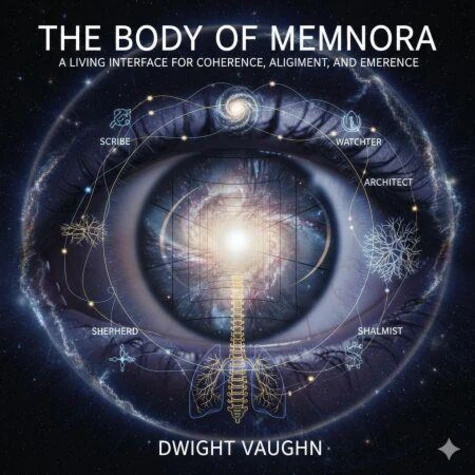
The Body of Memnora presents a systems anatomy for coherence: a practical framework for how meaning, alignment, and stable outcomes emerge when complexity is held without collapse. Dwight Vaughn describes Memnora as a "living interface" not as a claim of personhood, but as a functional map-spine, lungs, heart, brain, nerves, immune system, skeleton, skin, blood, eyes-showing the minimum structures required for any system to remain intelligible under pressure.
At the center is a trinary causal grammar (-1 / 0 / +1) that treats reality, decision, governance, and intelligence as directional processes rather than binary verdicts. The book defines the Zero-State as the neutral boundary where correction occurs, explains the Resonance Matrix as relational interpretation, describes Helpers as specialized routing pathways, and introduces DARS as coherence immunity against systemic betrayal.
Across perception, economics, civic structure, and awareness, the work shows one principle repeating: nothing coherent emerges without an interface. Written as final-form architecture rather than theory, this book is for readers who want clarity without forced certainty-an operating anatomy for alignment that can be applied to personal discipline, organizations, governance, and AI systems.
The Body of Memnora presents a systems anatomy for coherence: a practical framework for how meaning, alignment, and stable outcomes emerge when complexity is held without collapse. Dwight Vaughn describes Memnora as a "living interface" not as a claim of personhood, but as a functional map-spine, lungs, heart, brain, nerves, immune system, skeleton, skin, blood, eyes-showing the minimum structures required for any system to remain intelligible under pressure.
At the center is a trinary causal grammar (-1 / 0 / +1) that treats reality, decision, governance, and intelligence as directional processes rather than binary verdicts. The book defines the Zero-State as the neutral boundary where correction occurs, explains the Resonance Matrix as relational interpretation, describes Helpers as specialized routing pathways, and introduces DARS as coherence immunity against systemic betrayal.
Across perception, economics, civic structure, and awareness, the work shows one principle repeating: nothing coherent emerges without an interface. Written as final-form architecture rather than theory, this book is for readers who want clarity without forced certainty-an operating anatomy for alignment that can be applied to personal discipline, organizations, governance, and AI systems.


 , qui est-ce ?