Marcus du Sautoy has been named by the Independent on Sunday as one of the UK's leading scientists, has written extensively for the Guardian, The Times and the Daily Telegraph and has appeared on Radio 4 on numerous occasions. In 2008 he was appointed to Oxford University's prestigious professorship as the Simonyi Chair for the Public Understanding of Science, a post previously held by Richard Dawkins.
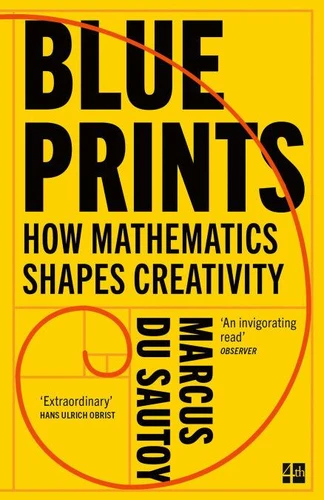
Blueprints. How mathematics shapes creativity
Par :Formats :
Disponible dans votre compte client Decitre ou Furet du Nord dès validation de votre commande. Le format ePub protégé est :
- Compatible avec une lecture sur My Vivlio (smartphone, tablette, ordinateur)
- Compatible avec une lecture sur liseuses Vivlio
- Pour les liseuses autres que Vivlio, vous devez utiliser le logiciel Adobe Digital Edition. Non compatible avec la lecture sur les liseuses Kindle, Remarkable et Sony
- Non compatible avec un achat hors France métropolitaine
 , qui est-ce ?
Notre partenaire de plateforme de lecture numérique où vous retrouverez l'ensemble de vos ebooks gratuitement
Pour en savoir plus sur nos ebooks, consultez notre aide en ligne ici
C'est si simple ! Lisez votre ebook avec l'app Vivlio sur votre tablette, mobile ou ordinateur :

- Nombre de pages304
- FormatePub
- ISBN978-0-00-868501-0
- EAN9780008685010
- Date de parution08/05/2025
- Protection num.Adobe DRM
- Infos supplémentairesepub
- ÉditeurFourth Estate
Résumé
*A Financial Times and Waterstones Book of the Year 2025*
Many artists are unaware of the mathematics that bubble beneath their craft, while some consciously use it for inspiration. Our instincts might tell us that these two subjects are incompatible forces with nothing in common, but what if we're wrong?
Marcus du Sautoy, acclaimed mathematician and Simonyi Professor for the Public Understanding of Science at the University of Oxford, looks to art, music, design and literature to uncover the key mathematical structures that underpin both human creativity and the natural world.
Blueprints takes us from the earliest stone circles to the modernist architecture of Le Corbusier, from Bach's circular compositions to Radiohead's disruptive soundscapes, and from Shakespeare's hidden numerical clues to the Dada artists who embraced randomness.
Instead of polar opposites we find a complementary relationship that spans a vast historical and geographic landscape. Whether we are searching for meaning in an abstract painting or deciphering poetry, there are blueprints everywhere: prime numbers, symmetry, fractals and the weirder worlds of Hamiltonian cycles and hyperbolic geometry. Nature similarly exploits these structures to achieve the wonders of our universe. In this innovative and delightfully bold exploration of creativity, Marcus explains how we make art, why a creative mindset is vital for discovering new mathematics and how a fundamental connection to the natural world intrinsically links these two subjects. 'Blueprints is an extraordinary book which shows us how mathematics and art are connected through structures.
Du Sautoy shows us how to bridge the divide of science and the humanities and proves that we can only face and solve the big challenges of the twenty-first century if we go beyond the fear of pooling knowledge' Hans Ulrich Obrist, Artistic Director, Serpentine Galleries
Instead of polar opposites we find a complementary relationship that spans a vast historical and geographic landscape. Whether we are searching for meaning in an abstract painting or deciphering poetry, there are blueprints everywhere: prime numbers, symmetry, fractals and the weirder worlds of Hamiltonian cycles and hyperbolic geometry. Nature similarly exploits these structures to achieve the wonders of our universe. In this innovative and delightfully bold exploration of creativity, Marcus explains how we make art, why a creative mindset is vital for discovering new mathematics and how a fundamental connection to the natural world intrinsically links these two subjects. 'Blueprints is an extraordinary book which shows us how mathematics and art are connected through structures.
Du Sautoy shows us how to bridge the divide of science and the humanities and proves that we can only face and solve the big challenges of the twenty-first century if we go beyond the fear of pooling knowledge' Hans Ulrich Obrist, Artistic Director, Serpentine Galleries
A propos de Marcus Du Sautoy
11,70 €
13,55 €
L'Art du raccourci ou comment mieux penser
Grand Format
23,00 €
6,99 €
12,99 €
How to Count to Infinity
E-book
3,99 €
9,99 €