Alexandria, 48 BCE. Julius Caesar is in the palace. The Library is still standing. A scribe has just read something that will get him killed. Nikomachos of Antioch arrives at the Mouseion, the greatest scholarly institution in the ancient world, with a scholarship reputation and no political instincts whatsoever. On his third day, he opens a door he has been told not to open and finds a financial record documenting payments to three people: a Roman officer from Caesar's staff, a senior official in the Ptolemaic court, and his own supervisor, the senior scribe Theron of Cyrene.
He should close the case and walk away. He has never once in his life walked away from something he was not supposed to read. What he finds behind the financial record is worse than corruption. In a double-locked room at the heart of the Library, a philosophical dialogue of anonymous authorship argues, from two centuries of historical precedent, that Caesar's ambitions will produce exactly what history tells us they did: a century of civil wars, successive succession crises, and the slow dissolution of the Republic into the empire that replaced it.
The text is not seditious. It is accurate. In 48 BCE, with Caesar forty feet from the throne, accurate is considerably more dangerous than seditious. Someone has already died for it. Nikomachos, who cannot unknow what he knows, must decide what to do with a document that three competing powers want and that the physician Miriam of Alexandria, who has been watching the institution's politics for thirty years and has been waiting for exactly this kind of person to arrive, has been preserving in her own way for considerably longer than Nikomachos has been alive.
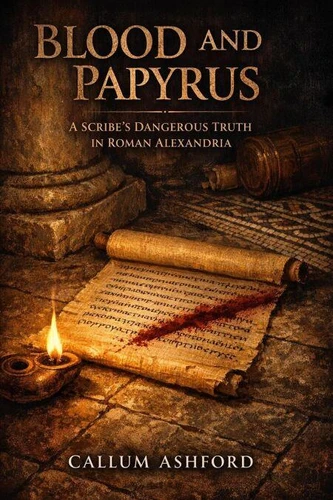
The fire is coming. Everyone who has read the signs knows it. The question is not whether the Library will burn but what can be saved before it does, and what it costs to be the person who decides. Blood and Papyrus is a literary historical thriller set against the documented final months of Alexandria's golden age, at the intersection of Caesar's ambition, Cleopatra's return, and the specific, quiet courage required to preserve an idea when the institutions built to protect ideas have already decided to look the other way.
For readers of Robert Harris's Pompeii, Donna Tartt's The Secret History, and Umberto Eco's The Name of the Rose.
Alexandria, 48 BCE. Julius Caesar is in the palace. The Library is still standing. A scribe has just read something that will get him killed. Nikomachos of Antioch arrives at the Mouseion, the greatest scholarly institution in the ancient world, with a scholarship reputation and no political instincts whatsoever. On his third day, he opens a door he has been told not to open and finds a financial record documenting payments to three people: a Roman officer from Caesar's staff, a senior official in the Ptolemaic court, and his own supervisor, the senior scribe Theron of Cyrene.
He should close the case and walk away. He has never once in his life walked away from something he was not supposed to read. What he finds behind the financial record is worse than corruption. In a double-locked room at the heart of the Library, a philosophical dialogue of anonymous authorship argues, from two centuries of historical precedent, that Caesar's ambitions will produce exactly what history tells us they did: a century of civil wars, successive succession crises, and the slow dissolution of the Republic into the empire that replaced it.
The text is not seditious. It is accurate. In 48 BCE, with Caesar forty feet from the throne, accurate is considerably more dangerous than seditious. Someone has already died for it. Nikomachos, who cannot unknow what he knows, must decide what to do with a document that three competing powers want and that the physician Miriam of Alexandria, who has been watching the institution's politics for thirty years and has been waiting for exactly this kind of person to arrive, has been preserving in her own way for considerably longer than Nikomachos has been alive.
The fire is coming. Everyone who has read the signs knows it. The question is not whether the Library will burn but what can be saved before it does, and what it costs to be the person who decides. Blood and Papyrus is a literary historical thriller set against the documented final months of Alexandria's golden age, at the intersection of Caesar's ambition, Cleopatra's return, and the specific, quiet courage required to preserve an idea when the institutions built to protect ideas have already decided to look the other way.
For readers of Robert Harris's Pompeii, Donna Tartt's The Secret History, and Umberto Eco's The Name of the Rose.


 , qui est-ce ?
