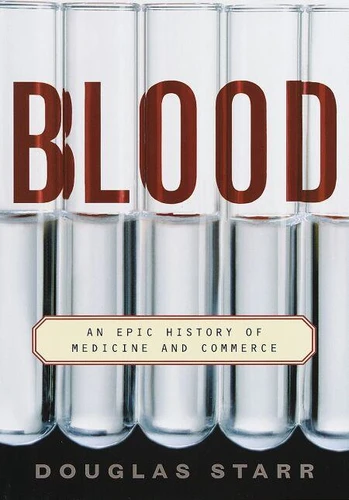
Blood. An Epic History of Medicine and Commerce
Par :Formats :
Disponible dans votre compte client Decitre ou Furet du Nord dès validation de votre commande. Le format ePub protégé est :
- Compatible avec une lecture sur My Vivlio (smartphone, tablette, ordinateur)
- Compatible avec une lecture sur liseuses Vivlio
- Pour les liseuses autres que Vivlio, vous devez utiliser le logiciel Adobe Digital Edition. Non compatible avec la lecture sur les liseuses Kindle, Remarkable et Sony
- Non compatible avec un achat hors France métropolitaine
 , qui est-ce ?
Notre partenaire de plateforme de lecture numérique où vous retrouverez l'ensemble de vos ebooks gratuitement
Pour en savoir plus sur nos ebooks, consultez notre aide en ligne ici
C'est si simple ! Lisez votre ebook avec l'app Vivlio sur votre tablette, mobile ou ordinateur :

- Nombre de pages464
- FormatePub
- ISBN978-0-307-82356-4
- EAN9780307823564
- Date de parution05/09/2012
- Protection num.Adobe DRM
- Taille2 Mo
- Infos supplémentairesepub
- ÉditeurKnopf
Résumé
Essence and emblem of life--feared, revered, mythologized, and used in magic and medicine from earliest times--human blood is now the center of a huge, secretive, and often dangerous worldwide commerce. It is a commerce whose impact upon humanity rivals that of any other business--millions of lives have been saved by blood and its various derivatives, and tens of thousands of lives have been lost.
Douglas Starr tells how this came to be, in a sweeping history that ranges through the centuries. With the dawn of science, blood came to be seen as a component of human anatomy, capable of being isolated, studied, used. Starr describes the first documented transfusion: In the seventeenth century, one of Louis XIV's court physicians transfers the blood of a calf into a madman to "cure" him. At the turn of the twentieth century a young researcher in Vienna identifies the basic blood groups, taking the first step toward successful transfusion.
Then a New York doctor finds a way to stop blood from clotting, thereby making all transfusion possible. In the 1930s, a Russian physician, in grisly improvisation, successfully uses cadaver blood to help living patients--and realizes that blood can be stored. The first blood bank is soon operating in Chicago. During World War II, researchers, driven by battlefield needs, break down blood into usable components that are more easily stored and transported.
This "fractionation" process--accomplished by a Harvard team--produces a host of pharmaceuticals, setting the stage for the global marketplace to come. Plasma, precisely because it can be made into long-lasting drugs, is shipped and traded for profit; today it is a $5 billion business. The author recounts the tragic spread of AIDS through the distribution of contaminated blood products, and describes why and how related scandals have erupted around the world.
Finally, he looks at the latest attempts to make artificial blood. Douglas Starr has written a groundbreaking book that tackles a subject of universal and urgent importance and explores the perils and promises that lie ahead.
Douglas Starr tells how this came to be, in a sweeping history that ranges through the centuries. With the dawn of science, blood came to be seen as a component of human anatomy, capable of being isolated, studied, used. Starr describes the first documented transfusion: In the seventeenth century, one of Louis XIV's court physicians transfers the blood of a calf into a madman to "cure" him. At the turn of the twentieth century a young researcher in Vienna identifies the basic blood groups, taking the first step toward successful transfusion.
Then a New York doctor finds a way to stop blood from clotting, thereby making all transfusion possible. In the 1930s, a Russian physician, in grisly improvisation, successfully uses cadaver blood to help living patients--and realizes that blood can be stored. The first blood bank is soon operating in Chicago. During World War II, researchers, driven by battlefield needs, break down blood into usable components that are more easily stored and transported.
This "fractionation" process--accomplished by a Harvard team--produces a host of pharmaceuticals, setting the stage for the global marketplace to come. Plasma, precisely because it can be made into long-lasting drugs, is shipped and traded for profit; today it is a $5 billion business. The author recounts the tragic spread of AIDS through the distribution of contaminated blood products, and describes why and how related scandals have erupted around the world.
Finally, he looks at the latest attempts to make artificial blood. Douglas Starr has written a groundbreaking book that tackles a subject of universal and urgent importance and explores the perils and promises that lie ahead.