SOLDES
Jusqu'à -70% sur une sélection d'articles*

Nouveauté
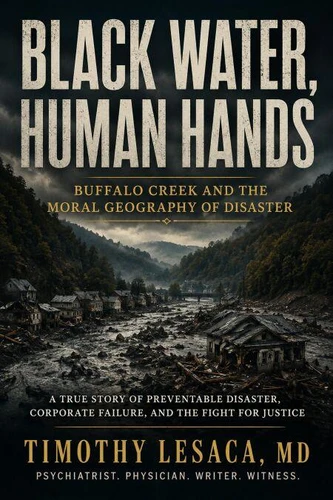
Black Water, Human Hands: Buffalo Creek and the Moral Geography of Disaster
Par :Formats :
Disponible dans votre compte client Decitre ou Furet du Nord dès validation de votre commande. Le format ePub est :
- Compatible avec une lecture sur My Vivlio (smartphone, tablette, ordinateur)
- Compatible avec une lecture sur liseuses Vivlio
- Pour les liseuses autres que Vivlio, vous devez utiliser le logiciel Adobe Digital Edition. Non compatible avec la lecture sur les liseuses Kindle, Remarkable et Sony
 , qui est-ce ?
Notre partenaire de plateforme de lecture numérique où vous retrouverez l'ensemble de vos ebooks gratuitement
Pour en savoir plus sur nos ebooks, consultez notre aide en ligne ici
C'est si simple ! Lisez votre ebook avec l'app Vivlio sur votre tablette, mobile ou ordinateur :

- FormatePub
- ISBN8233800252
- EAN9798233800252
- Date de parution17/05/2026
- Protection num.pas de protection
- Infos supplémentairesepub
- ÉditeurLinda Balsamo
Résumé
Black Water, Human Hands is a deeply researched and emotionally powerful examination of the Buffalo Creek flood of February 26, 1972-one of the deadliest and most preventable industrial disasters in American history. In the narrow coal hollows of Logan County, West Virginia, a coal-waste dam owned by the Pittston Coal Company collapsed after days of heavy rain, unleashing more than 130 million gallons of black water, slurry, and debris into the communities below.
In a matter of minutes, entire towns were destroyed, hundreds of homes disappeared, and 125 people lost their lives. Thousands more were left injured, homeless, traumatized, and permanently changed. But this book argues that Buffalo Creek was never simply a natural disaster. Drawing from government investigations, legal testimony, engineering reports, archival records, psychological research, oral histories, and survivor accounts, Timothy Lesaca, MD reconstructs not only the events of that morning, but the larger system that made the catastrophe possible.
The disaster emerged from decades of industrial practice in Appalachian coal country-an economy in which the benefits of extraction flowed outward while the risks remained concentrated in the communities nearest the mines. The flood was preceded by warnings, inspections, partial collapses, ignored engineering concerns, and repeated calls for emergency spillways that were never completed. Long before the dam failed, many people already feared what would happen if the water ever escaped.
At the center of the book are the people who lived below the dam. Through the stories of families such as Arthur and Barbara Brunty, rescuers who searched the mud for neighbors, investigators who uncovered the truth, and survivors who struggled for years with grief and displacement, Black Water, Human Hands restores the human scale of a disaster too often reduced to statistics. Kitchens, churches, schools, front porches, and familiar roads disappeared beneath the floodwaters.
Entire communities that had taken generations to build were erased in a single morning. The book examines not only the physical destruction, but also the psychological trauma that followed, including groundbreaking research into collective trauma conducted by psychiatrist Robert Jay Lifton and sociologist Kai Erikson, whose work at Buffalo Creek helped transform modern understanding of disaster psychology and community loss.
The book also explores the legal and ethical aftermath of the flood. Survivors fought powerful corporate and political systems in an effort to force recognition of what had happened to them. Lawyers, engineers, psychiatrists, and investigators confronted difficult questions about negligence, accountability, mental suffering, and the limits of the American legal system when faced with catastrophe on such a scale.
The phrase "act of God, " used by the company in the aftermath, becomes a central moral question running throughout the narrative: what happens when institutions attempt to shift responsibility for human decisions onto nature itself?At the same time, the book is about more than Buffalo Creek alone. It is an examination of how modern societies distribute risk, conceal the geography of extraction, and normalize dangers borne disproportionately by vulnerable communities.
Coal powered factories, railroads, steel production, electricity, and economic expansion across the nation, but the instability, waste, and environmental danger remained concentrated in places like Buffalo Creek. The hollow became a sacrifice zone for a prosperity enjoyed far beyond Appalachia.
In a matter of minutes, entire towns were destroyed, hundreds of homes disappeared, and 125 people lost their lives. Thousands more were left injured, homeless, traumatized, and permanently changed. But this book argues that Buffalo Creek was never simply a natural disaster. Drawing from government investigations, legal testimony, engineering reports, archival records, psychological research, oral histories, and survivor accounts, Timothy Lesaca, MD reconstructs not only the events of that morning, but the larger system that made the catastrophe possible.
The disaster emerged from decades of industrial practice in Appalachian coal country-an economy in which the benefits of extraction flowed outward while the risks remained concentrated in the communities nearest the mines. The flood was preceded by warnings, inspections, partial collapses, ignored engineering concerns, and repeated calls for emergency spillways that were never completed. Long before the dam failed, many people already feared what would happen if the water ever escaped.
At the center of the book are the people who lived below the dam. Through the stories of families such as Arthur and Barbara Brunty, rescuers who searched the mud for neighbors, investigators who uncovered the truth, and survivors who struggled for years with grief and displacement, Black Water, Human Hands restores the human scale of a disaster too often reduced to statistics. Kitchens, churches, schools, front porches, and familiar roads disappeared beneath the floodwaters.
Entire communities that had taken generations to build were erased in a single morning. The book examines not only the physical destruction, but also the psychological trauma that followed, including groundbreaking research into collective trauma conducted by psychiatrist Robert Jay Lifton and sociologist Kai Erikson, whose work at Buffalo Creek helped transform modern understanding of disaster psychology and community loss.
The book also explores the legal and ethical aftermath of the flood. Survivors fought powerful corporate and political systems in an effort to force recognition of what had happened to them. Lawyers, engineers, psychiatrists, and investigators confronted difficult questions about negligence, accountability, mental suffering, and the limits of the American legal system when faced with catastrophe on such a scale.
The phrase "act of God, " used by the company in the aftermath, becomes a central moral question running throughout the narrative: what happens when institutions attempt to shift responsibility for human decisions onto nature itself?At the same time, the book is about more than Buffalo Creek alone. It is an examination of how modern societies distribute risk, conceal the geography of extraction, and normalize dangers borne disproportionately by vulnerable communities.
Coal powered factories, railroads, steel production, electricity, and economic expansion across the nation, but the instability, waste, and environmental danger remained concentrated in places like Buffalo Creek. The hollow became a sacrifice zone for a prosperity enjoyed far beyond Appalachia.