SOLDES
Jusqu'à -70% sur une sélection d'articles*

Nouveauté
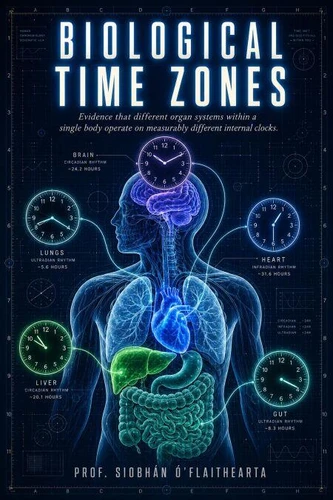
Biological Time Zones: Evidence that different organ systems within a single body operate on measurably different internal clocks
Par :Formats :
Disponible dans votre compte client Decitre ou Furet du Nord dès validation de votre commande. Le format ePub est :
- Compatible avec une lecture sur My Vivlio (smartphone, tablette, ordinateur)
- Compatible avec une lecture sur liseuses Vivlio
- Pour les liseuses autres que Vivlio, vous devez utiliser le logiciel Adobe Digital Edition. Non compatible avec la lecture sur les liseuses Kindle, Remarkable et Sony
 , qui est-ce ?
Notre partenaire de plateforme de lecture numérique où vous retrouverez l'ensemble de vos ebooks gratuitement
Pour en savoir plus sur nos ebooks, consultez notre aide en ligne ici
C'est si simple ! Lisez votre ebook avec l'app Vivlio sur votre tablette, mobile ou ordinateur :

- FormatePub
- ISBN8235712447
- EAN9798235712447
- Date de parution19/06/2026
- Protection num.pas de protection
- Infos supplémentairesepub
- ÉditeurIoakim Ioakim
Résumé
Your heart and your liver do not know the same time. At this moment, regardless of what your watch says, each organ in your body is running its own biological clock, cycling through its own daily rhythm of activity and rest, and those rhythms do not all point in the same direction. This is not a metaphor. It is measurable molecular biology, and it changes everything about how we should understand health, disease, and the timing of treatment.
Biological Time Zones begins where most biology textbooks stop. Yes, there is a master clock in the brain, a cluster of twenty thousand neurons in the hypothalamus called the suprachiasmatic nucleus, and yes, its mechanisms were recognised by the 2017 Nobel Prize in Physiology or Medicine. But the master clock is not a dictator. It is a coordinator, and the organs it coordinates are not fully obedient.
Each has its own molecular clockwork, its own dominant time cue, and its own capacity to drift out of phase when life pushes it in a different direction. The liver follows food, not light. Change when you eat, and within a week your liver clock has shifted to align with the new meal schedule while your brain clock, anchored by morning light, stays where it was. The result is two clocks in the same body running several hours apart, and the metabolic consequences of that misalignment are well-documented and serious.
The heart's circadian programme makes the morning hours most dangerous for people with cardiovascular disease, as platelet aggregability, blood pressure, and catecholamine levels all peak simultaneously in the first hour after waking. Asthma is a nocturnal disease because the lung clock makes airways most reactive at four in the morning. The immune system schedules its most intensive patrol and killing activity during the hours of sleep.
These are not incidental observations. They are fundamental features of how the body works that modern medicine is only beginning to account for. Prof. Siobhán Ó'Flaithearta makes the case throughout for a medicine that takes biological time seriously: not just the time of day, but the specific clock phase of the organ being treated. The evidence she marshals is already applied in select clinical settings.
Bedtime antihypertensives. Morning vaccinations. Evening inhaled corticosteroids. Cancer drug infusions timed precisely to the tumour cell cycle. Each of these rests on the same foundational insight: the right treatment at the right time depends entirely on understanding which clock you are treating and what time that clock is keeping. This is one of the most consequential scientific shifts in modern medicine.
This book is how it becomes visible.
Biological Time Zones begins where most biology textbooks stop. Yes, there is a master clock in the brain, a cluster of twenty thousand neurons in the hypothalamus called the suprachiasmatic nucleus, and yes, its mechanisms were recognised by the 2017 Nobel Prize in Physiology or Medicine. But the master clock is not a dictator. It is a coordinator, and the organs it coordinates are not fully obedient.
Each has its own molecular clockwork, its own dominant time cue, and its own capacity to drift out of phase when life pushes it in a different direction. The liver follows food, not light. Change when you eat, and within a week your liver clock has shifted to align with the new meal schedule while your brain clock, anchored by morning light, stays where it was. The result is two clocks in the same body running several hours apart, and the metabolic consequences of that misalignment are well-documented and serious.
The heart's circadian programme makes the morning hours most dangerous for people with cardiovascular disease, as platelet aggregability, blood pressure, and catecholamine levels all peak simultaneously in the first hour after waking. Asthma is a nocturnal disease because the lung clock makes airways most reactive at four in the morning. The immune system schedules its most intensive patrol and killing activity during the hours of sleep.
These are not incidental observations. They are fundamental features of how the body works that modern medicine is only beginning to account for. Prof. Siobhán Ó'Flaithearta makes the case throughout for a medicine that takes biological time seriously: not just the time of day, but the specific clock phase of the organ being treated. The evidence she marshals is already applied in select clinical settings.
Bedtime antihypertensives. Morning vaccinations. Evening inhaled corticosteroids. Cancer drug infusions timed precisely to the tumour cell cycle. Each of these rests on the same foundational insight: the right treatment at the right time depends entirely on understanding which clock you are treating and what time that clock is keeping. This is one of the most consequential scientific shifts in modern medicine.
This book is how it becomes visible.