
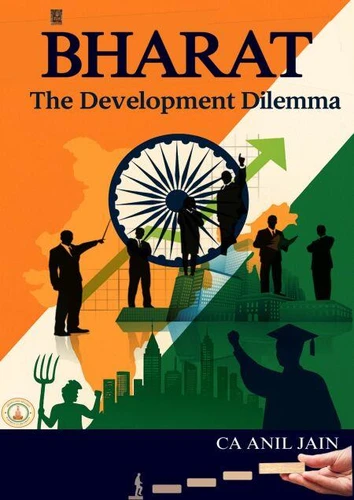
BHARAT........"The Development Dilemma"
Par :Formats :
Disponible dans votre compte client Decitre ou Furet du Nord dès validation de votre commande. Le format ePub est :
- Compatible avec une lecture sur My Vivlio (smartphone, tablette, ordinateur)
- Compatible avec une lecture sur liseuses Vivlio
- Pour les liseuses autres que Vivlio, vous devez utiliser le logiciel Adobe Digital Edition. Non compatible avec la lecture sur les liseuses Kindle, Remarkable et Sony
 , qui est-ce ?
Notre partenaire de plateforme de lecture numérique où vous retrouverez l'ensemble de vos ebooks gratuitement
Pour en savoir plus sur nos ebooks, consultez notre aide en ligne ici
C'est si simple ! Lisez votre ebook avec l'app Vivlio sur votre tablette, mobile ou ordinateur :

- FormatePub
- ISBN8231967971
- EAN9798231967971
- Date de parution14/07/2025
- Protection num.pas de protection
- Infos supplémentairesepub
- ÉditeurWalzone Press
Résumé
BHARAT........"The development dilemma"This book is perhaps the first comprehensive, research-backed attempt to analyse India's economic journey in depth. It identifies key structural impediments and proposes actionable policy solutions. Aimed at policymakers, economists, academics, and informed readers, the book bridges crucial knowledge gaps and advocates for strategic reforms often unconventional and based on out-of-the-box thinking to help India realise its aspiration of becoming a robust economy and a global economic powerhouse.
India, currently the world's fifth-largest economy by nominal GDP and third-largest by purchasing power parity (PPP), has a diverse economic structure comprising agriculture, industry, and a dominant services sector. Since gaining independence in 1947, India has transitioned from a mixed economy to a more liberalized one, especially after the 1991 economic reforms that opened the country to global trade and investment.
Agriculture still employs over 40% of the workforce but contributes only 16-18% to GDP, reflecting persistent structural challenges. Industry and manufacturing account for about 25-30% of GDP, buoyed by initiatives like "Make in India, " while the services sector-led by IT, finance, and telecommunications-drives more than 50% of the economy. Despite impressive GDP growth, India continues to face several enduring challenges, including infrastructure deficits, high unemployment, complex regulatory frameworks, corruption, and regional disparities in education and development.
These persistent issues hinder the full impact of developmental efforts, particularly at the grassroots level. This research-based book delves deeply into each of these challenges and proposes bold, sometimes radical, solutions to overcome them. Many of the issues, the book argues, are solvable with the right policies and governance, which could significantly accelerate the country's development trajectory.
This book will prove invaluable for policymakers, aspirants preparing for competitive examinations, management institutions, and anyone interested in understanding the complexities and opportunities of the Indian economic landscape.
India, currently the world's fifth-largest economy by nominal GDP and third-largest by purchasing power parity (PPP), has a diverse economic structure comprising agriculture, industry, and a dominant services sector. Since gaining independence in 1947, India has transitioned from a mixed economy to a more liberalized one, especially after the 1991 economic reforms that opened the country to global trade and investment.
Agriculture still employs over 40% of the workforce but contributes only 16-18% to GDP, reflecting persistent structural challenges. Industry and manufacturing account for about 25-30% of GDP, buoyed by initiatives like "Make in India, " while the services sector-led by IT, finance, and telecommunications-drives more than 50% of the economy. Despite impressive GDP growth, India continues to face several enduring challenges, including infrastructure deficits, high unemployment, complex regulatory frameworks, corruption, and regional disparities in education and development.
These persistent issues hinder the full impact of developmental efforts, particularly at the grassroots level. This research-based book delves deeply into each of these challenges and proposes bold, sometimes radical, solutions to overcome them. Many of the issues, the book argues, are solvable with the right policies and governance, which could significantly accelerate the country's development trajectory.
This book will prove invaluable for policymakers, aspirants preparing for competitive examinations, management institutions, and anyone interested in understanding the complexities and opportunities of the Indian economic landscape.
