
Aaryan Agrawal is pursuing a degree in Apllied physics at Dartmouth College.
Vishal Agarwal is pursuing a degree in Computer Science at the Washington University in St. Louis along with an intended second major in Physics. He has always had a great interest in natural sciences especially in the overlap it has with the Vedic scriptures
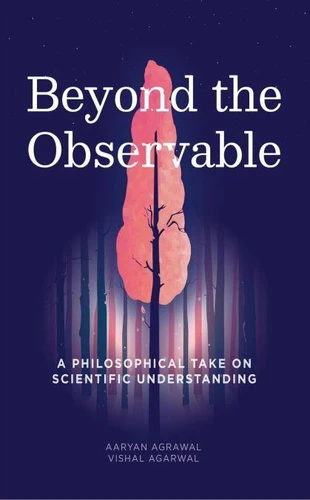
Beyond the Observable - A Philosophical Take on Scientific Understanding
Par : ,Formats :
Disponible dans votre compte client Decitre ou Furet du Nord dès validation de votre commande. Le format ePub est :
- Compatible avec une lecture sur My Vivlio (smartphone, tablette, ordinateur)
- Compatible avec une lecture sur liseuses Vivlio
- Pour les liseuses autres que Vivlio, vous devez utiliser le logiciel Adobe Digital Edition. Non compatible avec la lecture sur les liseuses Kindle, Remarkable et Sony
 , qui est-ce ?
Notre partenaire de plateforme de lecture numérique où vous retrouverez l'ensemble de vos ebooks gratuitement
Pour en savoir plus sur nos ebooks, consultez notre aide en ligne ici
C'est si simple ! Lisez votre ebook avec l'app Vivlio sur votre tablette, mobile ou ordinateur :

- FormatePub
- ISBN978-93-5559-064-0
- EAN9789355590640
- Date de parution15/06/2022
- Protection num.pas de protection
- Infos supplémentairesepub
- ÉditeurLeadstart
Résumé
A philosophical take on scientific understandingSince their very dawn, humans have been inherently hungry and persistently foolish. Our curiosity has created a large system of knowledge-a forest, so to speak. Yet, almost all our knowledge is exhibited to us in a form that is inherently embedded in a particular discipline. But what if we free this knowledge from all subjective biases and absorb what it has to offer?While all of us do look at these metaphorical trees of knowledge individually, sometimes looking beyond teaches us more.
But what can we learn when we take a step back and zoom out? What does, say, astrophysics teach us about our own equation of happiness? And the nature of an economy about our daily social interactions?These correlations open themselves up to interpretations for the reader, be it the purpose of humanity or the meaning of spirituality. Yet, on our quest for infinitely greater knowledge, will we ever reach the end?
But what can we learn when we take a step back and zoom out? What does, say, astrophysics teach us about our own equation of happiness? And the nature of an economy about our daily social interactions?These correlations open themselves up to interpretations for the reader, be it the purpose of humanity or the meaning of spirituality. Yet, on our quest for infinitely greater knowledge, will we ever reach the end?