
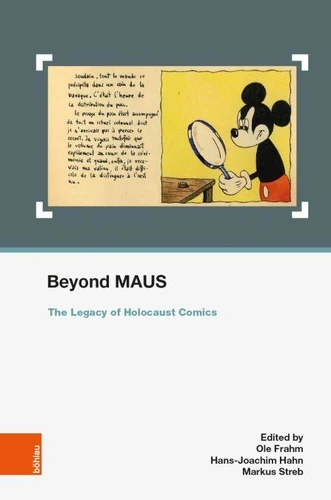
Beyond MAUS. The Legacy of Holocaust Comics
Par : , , , ,Formats :
Disponible dans votre compte client Decitre ou Furet du Nord dès validation de votre commande. Le format PDF est :
- Compatible avec une lecture sur My Vivlio (smartphone, tablette, ordinateur)
- Compatible avec une lecture sur liseuses Vivlio
- Pour les liseuses autres que Vivlio, vous devez utiliser le logiciel Adobe Digital Edition. Non compatible avec la lecture sur les liseuses Kindle, Remarkable et Sony
 , qui est-ce ?
Notre partenaire de plateforme de lecture numérique où vous retrouverez l'ensemble de vos ebooks gratuitement
Pour en savoir plus sur nos ebooks, consultez notre aide en ligne ici
C'est si simple ! Lisez votre ebook avec l'app Vivlio sur votre tablette, mobile ou ordinateur :

- Nombre de pages420
- FormatPDF
- ISBN978-3-205-21066-5
- EAN9783205210665
- Date de parution09/08/2021
- Protection num.pas de protection
- Taille45 Mo
- Infos supplémentairespdf
- ÉditeurBöhlau
Résumé
Beyond MAUS. The Legacy of Holocaust Comics collects 16 contributions that shed new light on the representation of the Holocaust. While MAUS by Art Spiegelman has changed the perspectives, other comics and series of drawings, some produced while the Holocaust happened, are often not recognised by a wider public. A plethora of works still waits to be discovered, like early caricatures and comics referring to the extermination of the Jews, graphic series by survivors or horror stories from 1950s comic books.
The volume provides overviews about the depictions of Jews as animals, the representation of prisoner societies in comics as well as in depth studies about distorted traces of the Holocaust in Hergé's Tintin and in Spirou, the Holocaust in Mangas, and Holocaust comics in Poland and Israel, recent graphic novels and the use of these comics in schools. With contributions from different disciplines, the volume also grants new perspectives on comic scholarship.
The volume provides overviews about the depictions of Jews as animals, the representation of prisoner societies in comics as well as in depth studies about distorted traces of the Holocaust in Hergé's Tintin and in Spirou, the Holocaust in Mangas, and Holocaust comics in Poland and Israel, recent graphic novels and the use of these comics in schools. With contributions from different disciplines, the volume also grants new perspectives on comic scholarship.
A propos de Ole Frahm
Räume, Orte, Kollektive
E-book
18,00 €